
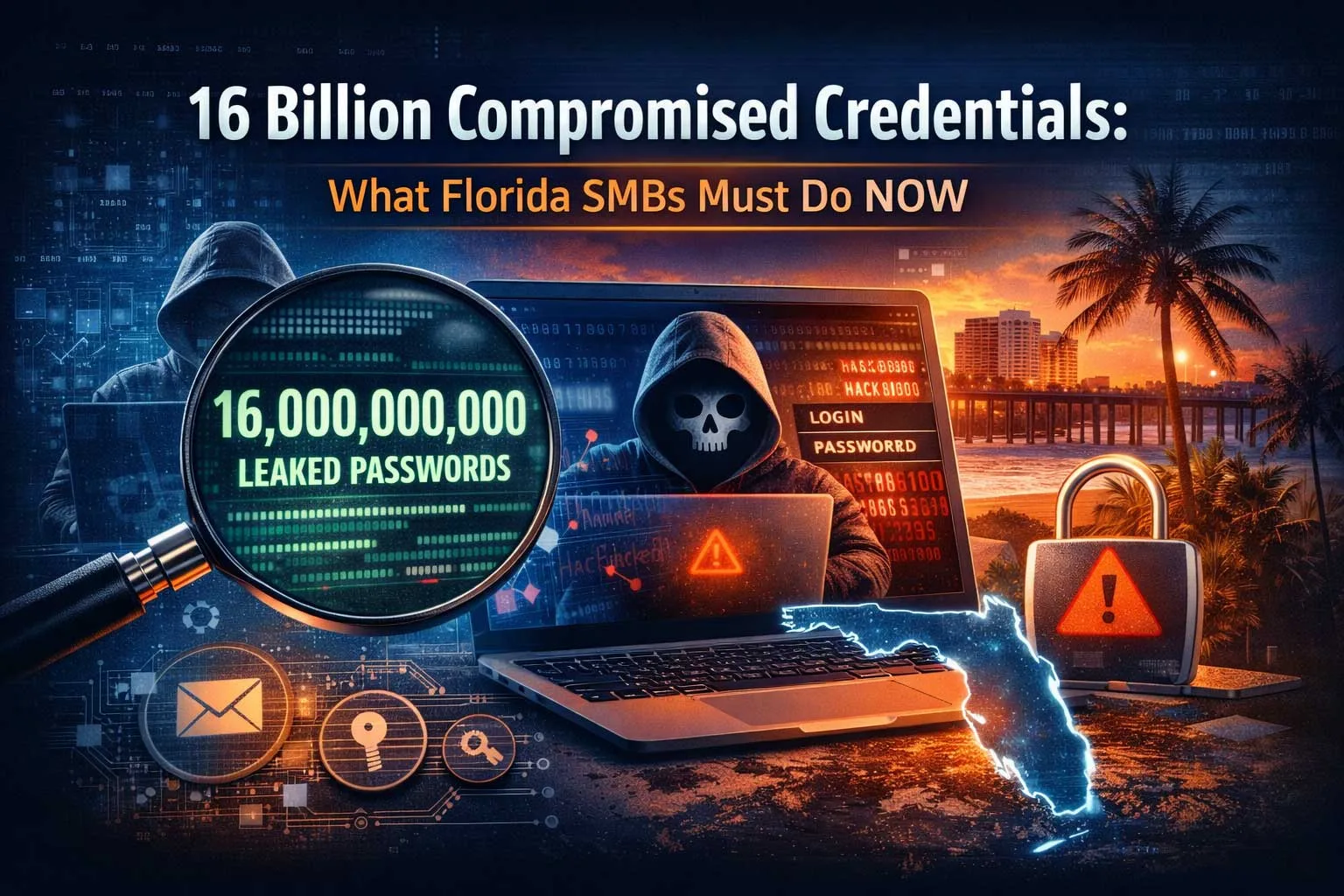
The discovery of 16 billion compromised credentials across 30 exposed datasets is more than just another cybersecurity headline. For small and mid-sized businesses in Florida, this is a serious warning.
Researchers uncovered a massive collection of usernames and passwords compiled from years of infostealer malware infections and older breaches. This was not one single hack. It was the result of continuous credential theft happening quietly in the background for years.
For Florida SMBs in healthcare, legal, financial services, and retail, the risk is immediate. Stolen credentials are now fueling automated attacks that specifically target businesses with limited security resources.
If your employees reuse passwords, rely only on basic login protections, or have never checked the dark web for exposed data, your organization could already be vulnerable.
16 Billion Compromised Credentials – Table of Contents
What Are the 16 Billion Compromised Credentials?
The term 16 billion compromised credentials refers to login combinations such as email addresses and passwords found across 30 large datasets.
Important clarification:
- This was not a direct breach of Apple or Google
- The data was compiled from multiple older breaches
- Much of it was harvested by infostealer malware
- Duplicates likely exist
Even if a portion is outdated, the scale changes the threat landscape.
If just 0.1 percent of these credentials remain valid, that equals 16 million usable login combinations.
That is more than enough for attackers to cause widespread damage.
Why Florida SMBs Are Prime Targets
Cybercriminals no longer focus only on large enterprises. In fact, small and mid-sized businesses are often easier targets.
Many Florida SMBs:
- Do not enforce strong password policies
- Rely on basic email security
- Have limited monitoring
- Lack dedicated cybersecurity staff
- Operate under compliance regulations such as HIPAA
Industries across Palm Coast, Daytona Beach, Jacksonville, and St Augustine are especially exposed if they handle financial data, patient information, or legal records.
Stolen credentials are often the entry point for:
- Business email compromise
- Ransomware attacks
- Unauthorized wire transfers
- Client data breaches
Most breaches today begin with valid login credentials, not sophisticated hacking tools.
How Infostealer Malware Fueled the 16 Billion Dataset
Infostealer malware is designed to extract data from infected devices.
It can:
- Pull saved browser passwords
- Capture session cookies
- Extract autofill data
- Access crypto wallets
- Harvest system credentials
Infections often happen through:
- Fake software updates
- Pirated downloads
- Phishing emails
- Malicious ads
Once collected, credentials are packaged and sold on underground forums. Over time, these logs are compiled into searchable databases.
That is how the 16 billion compromised credentials dataset came to exist.
Credential Stuffing: The Real Business Risk
Attackers use automation to test stolen credentials across multiple platforms. This method is known as credential stuffing.
Here is how it works:
- Criminals obtain stolen username and password combinations
- Automated bots test them against business portals
- If users reuse passwords, access is granted
For Florida SMBs, this could mean:
- Microsoft 365 compromise
- QuickBooks access
- Banking portal infiltration
- CRM system takeover
- Cloud storage exposure
Even if your infrastructure is secure, reused passwords can bypass everything.
The Compliance Risk for Florida Businesses
If you operate in healthcare, finance, or legal services, credential exposure can trigger regulatory consequences.
Failure to implement proper safeguards may lead to:
- HIPAA violations
- Financial compliance penalties
- Legal liability
- Loss of client trust
- Reputational damage
Cyber insurance carriers are also tightening requirements. Many now require multi-factor authentication and monitoring controls.
The exposure of 16 billion compromised credentials strengthens the argument that password-only security is no longer sufficient.
How Zevonix Protects Florida SMBs
At Zevonix, we work with Florida small and mid-sized businesses to reduce exposure from credential-based attacks.
Here is how we help:
1. Dark Web Monitoring
Zevonix provides continuous dark web monitoring for:
- Employee email addresses
- Business domains
- Executive accounts
- High-risk users
If your credentials appear in underground marketplaces or breach datasets, you are notified immediately.
Early detection allows:
- Rapid password resets
- Account lockdown
- Access audits
- Threat containment
Dark web monitoring turns unknown exposure into actionable intelligence.
2. Multi-Factor Authentication Enforcement
We implement and enforce strong MFA policies across:
- Microsoft 365
- Cloud applications
- Remote access portals
- Administrative accounts
Phishing-resistant authentication methods dramatically reduce credential stuffing success.
3. Identity and Access Hardening
Zevonix helps Florida SMBs:
- Disable legacy authentication protocols
- Enforce strong password standards
- Implement conditional access policies
- Limit administrative privileges
- Monitor abnormal login activity
Credential compromise should not automatically equal system compromise.
4. Ongoing Security Monitoring
We continuously monitor:
- Suspicious login attempts
- Geographic anomalies
- Impossible travel events
- Brute force activity
- Compromised password alerts
This proactive monitoring reduces the likelihood of successful account takeover.
Immediate Steps Florida Business Owners Should Take
If you are concerned about the 16 billion compromised credentials, here are practical steps you can take today:
- Enable MFA on every critical system
- Stop password reuse across platforms
- Use a reputable password manager
- Scan devices for malware
- Remove unused accounts
- Check whether your domain appears in breach datasets
- Consider professional dark web monitoring
Assume exposure is possible. Prepare accordingly.
The Bigger Picture
The 16 billion compromised credentials dataset highlights a structural problem.
Passwords are weak by design. They are reused, stored insecurely, and stolen at scale.
Cybercrime has evolved into an automated economy built on credential reuse.
For Florida SMBs, the question is no longer whether credentials will leak.
The real question is whether your business will detect exposure before attackers exploit it.
Frequently Asked Questions
Is this a new breach?
No. The 16 billion compromised credentials are aggregated from multiple older breaches and infostealer campaigns.
Are Florida small businesses really at risk?
Yes. SMBs are often targeted because they lack enterprise-level defenses.
Does dark web monitoring prevent breaches?
It does not prevent initial theft, but it allows early detection so action can be taken before exploitation.
What industries in Florida are most at risk?
Healthcare, financial services, legal practices, retail, and professional services face elevated risk due to sensitive data exposure.
Our Final Thoughts for Florida SMBs
The exposure of 16 billion compromised credentials is not just a global cybersecurity statistic. It is a practical risk affecting businesses across Florida.
Credential-based attacks are automated, inexpensive for criminals, and highly scalable.
If your organization relies on passwords alone, you are operating in a high-risk environment.
Zevonix helps Florida SMBs reduce exposure through dark web monitoring, identity protection, and proactive cybersecurity management.
If you want to know whether your business credentials are circulating online, start by monitoring what you cannot see.
Your security posture should not depend on hope. It should depend on visibility and action.
Schedule A Quick Consultation
📞 Call us at 904.658.0777
🔒 Book Your meeting with Zevonix »
Stay Informed
Want smarter insights without the noise? Get our latest ideas and strategies delivered right to your inbox.
We respect your privacy. Unsubscribe at any time.