

If you run a small or mid-sized business, small business compliance can feel like a maze of acronyms written for someone else. HIPAA, PCI-DSS, CCPA, GDPR – which of these actually apply to you?
The honest answer is that most businesses are subject to at least one set of rules, often without realizing it. The moment you accept a credit card or store a customer’s personal details, a regulation may already be in play.
This guide breaks down the major rules in plain English, helps you figure out which ones apply to your business, and explains what each one expects of you at a high level.
Quick but important note: this is general information, not legal advice. For your specific situation, talk to a qualified attorney or compliance professional.
Which Compliance Rules Apply to Your Business? A 2026 Guide to HIPAA, PCI-DSS and CCPA – Table of Contents
Why Small Business Compliance Matters More Than You Think
Regulations exist to protect sensitive data – patient records, payment details, and personal information. When you handle that data, you take on responsibility for keeping it safe.
Many owners assume these rules only target large corporations. In reality, regulators and cybercriminals both pay close attention to smaller organizations, which often have fewer defenses.
Good small business compliance is not just about avoiding penalties. It builds customer trust, reduces breach risk, and gives you a clear framework for protecting the data your business depends on.
HIPAA Compliance: For Healthcare and Anyone Handling PHI
HIPAA compliance applies to healthcare providers, health plans, and healthcare clearinghouses – and to the vendors who handle health data on their behalf, known as business associates.
The key trigger is Protected Health Information, or PHI. That means any health-related information tied to an identifiable person, from diagnoses to billing records.
Who needs to comply
- Medical and dental practices, clinics, and therapists
- Health insurers and billing companies
- IT providers, software vendors, and contractors that touch PHI
Core safeguards HIPAA expects
- Administrative safeguards – written policies, staff training, and risk assessments.
- Physical safeguards – controlling access to facilities and devices.
- Technical safeguards – encryption, access controls, and audit logs.
If your business creates, receives, stores, or transmits PHI, HIPAA almost certainly applies to you.
PCI-DSS Compliance: For Any Business Taking Card Payments
PCI-DSS compliance is one of the most widely applicable rules, yet one of the most overlooked. If your business accepts credit or debit cards in any form, it applies to you.
PCI-DSS stands for Payment Card Industry Data Security Standard. It is not a government law but a requirement set by the major card brands, and your bank can enforce it.
This includes you if you
- Swipe, tap, or key in cards at a register
- Take payments online or over the phone
- Store, process, or transmit cardholder data in any way
At a high level, PCI-DSS asks you to protect cardholder data, maintain secure networks, restrict access, and regularly test your systems. The exact requirements scale with how many transactions you process.
Even if a third party handles your payments, you still share responsibility for choosing compliant tools and documenting your setup.
CCPA Compliance: Consumer Data Privacy
CCPA compliance centers on consumer privacy rights. The California Consumer Privacy Act, expanded by the CPRA, gives California residents control over how businesses collect and use their personal information.
You do not have to be located in California to be covered. What matters is whether you collect personal data from California residents and meet certain thresholds.
CCPA generally applies if you
- Have annual gross revenue above a defined threshold, or
- Buy, sell, or share the personal information of a large number of consumers, or
- Earn a significant share of revenue from selling personal information
If covered, you must tell consumers what you collect, honor requests to access or delete their data, and let them opt out of having their information sold or shared.
Several other states have passed similar privacy laws, so it is wise to track requirements beyond California if you serve customers nationwide.
A Quick Nod to GDPR for EU Customers
If you market to or serve customers in the European Union, the General Data Protection Regulation may apply – even from the United States.
GDPR sets strict rules on consent, data handling, and individual privacy rights. The penalties can be significant, so EU-facing businesses should confirm where they stand.
Which Compliance Rules Apply to My Business?
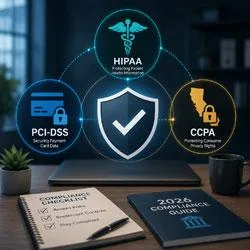
Here is a simple way to think through your IT compliance requirements. Work through these questions honestly.
- Do you handle health information? If you create or touch PHI, expect HIPAA.
- Do you accept card payments? If yes, PCI-DSS applies, period.
- Do you collect personal data from California residents at scale? CCPA/CPRA may apply.
- Do you serve EU customers? GDPR may apply.
Most businesses answer “yes” to more than one. A medical practice that takes card payments, for example, faces both HIPAA and PCI-DSS.
Mapping which rules apply is the foundation of any compliance program. From there, you can focus your time and budget where it actually matters.
The Real Cost of Getting It Wrong
Non-compliance carries three kinds of cost, and none of them are small.
Fines and penalties
Regulators can issue penalties that climb quickly, especially when violations are seen as willful or repeated. Across the industry, fines often range from thousands to well into the hundreds of thousands of dollars.
Breach and recovery costs
A data breach brings investigation, notification, and remediation expenses. Industry studies routinely put the average cost of a breach in the millions, with smaller firms hit hard relative to their size.
Reputation damage
The hardest cost to measure is lost trust. Customers who learn their data was mishandled may simply walk away, and that damage can outlast any fine.
What an IT Compliance Assessment Involves
Before you can fix gaps, you need to know where they are. That is the purpose of a compliance assessment, often called a gap analysis.
A thorough assessment typically covers:
- Data mapping – identifying what sensitive data you hold and where it lives.
- Risk analysis – finding weak points in your systems and processes.
- Policy review – checking that written policies match the relevant standards.
- Technical controls – confirming encryption, access controls, and backups are in place.
- Remediation plan – a prioritized list of what to fix and in what order.
The result is a clear picture of where you stand and a practical roadmap to close the gaps. This is also how you prepare for a compliance audit, because auditors look for exactly this kind of documented diligence.
How Managed Compliance Support Helps
Compliance is not a one-time project. Rules change, systems change, and staff turn over. Meeting your IT compliance requirements is an ongoing effort.
This is where managed support makes a difference. A security-first IT partner helps you stay continuously ready instead of scrambling before each audit.
Ongoing support typically includes
- Monitoring – watching systems for threats and policy drift around the clock.
- Documentation – keeping the records and evidence auditors expect.
- Audit preparation – organizing proof and walking you through the process.
- Updates – adjusting controls as regulations and threats evolve.
With the right partner, compliance becomes a steady, manageable routine rather than a yearly fire drill. Zevonix builds compliance into proactive, security-first IT through our managed compliance support services, guided by our proprietary Six-Step Pathway and decades of field experience.
Get Clear on Your Compliance – Talk to Zevonix
Strong small business compliance starts with knowing exactly which rules apply to you and where your gaps are. You do not have to untangle HIPAA, PCI-DSS, and CCPA on your own.
Zevonix helps businesses across Florida – including Jacksonville and Palm Coast – and Georgia – including Atlanta and Savannah – assess, document, and maintain compliance with confidence. Contact our team today for a friendly, plain-English conversation about your IT compliance requirements.
Stay Informed
Want smarter insights without the noise? Get our latest ideas and strategies delivered right to your inbox.
We respect your privacy. Unsubscribe at any time.