
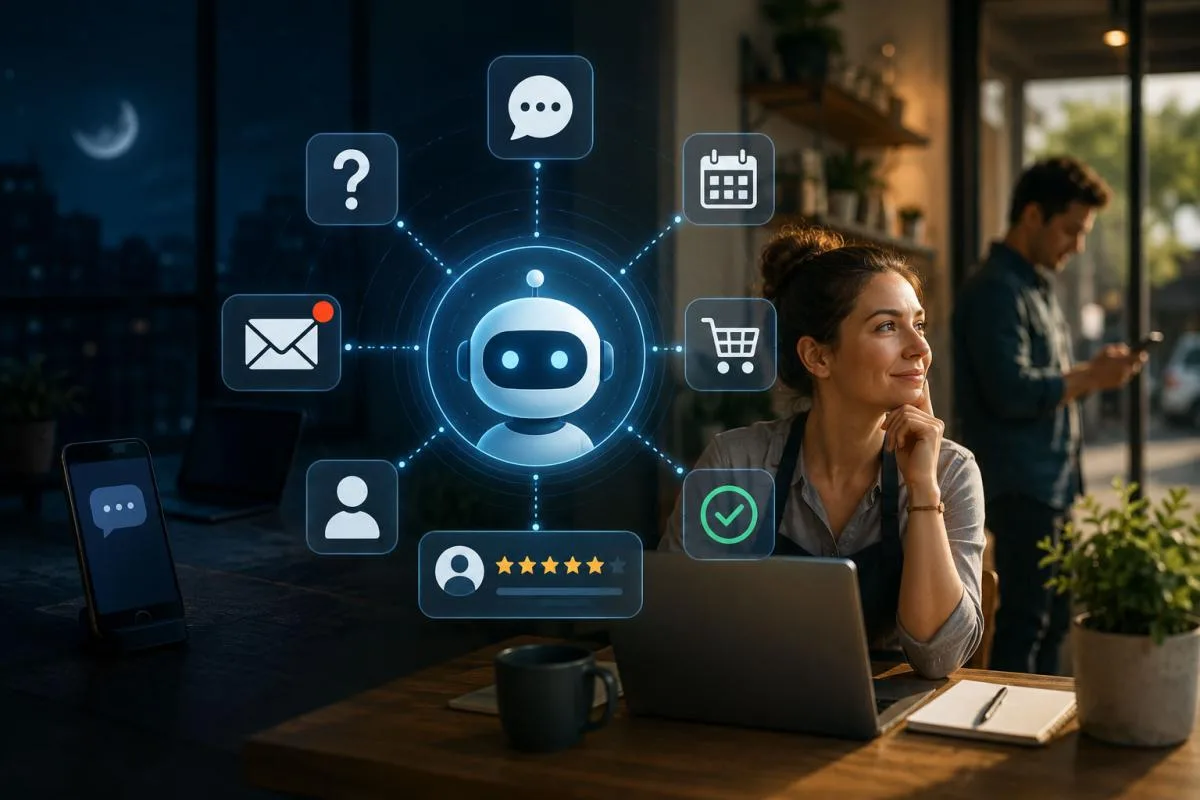
Your phone rings after hours, an email sits unanswered overnight, and a potential customer clicks away because no one replied fast enough. For a small business, every missed message can mean a missed sale.
This is exactly the problem that AI chatbots for small business are built to solve. They give you a way to answer questions, capture leads, and support customers around the clock without hiring a single extra person.
An AI chatbot is software that chats with your customers in plain language, usually through your website or messaging apps. A virtual assistant takes that idea further, handling tasks like booking appointments or checking order status.
In this guide, you will learn what these tools can and cannot do, where they help most, and how to roll one out responsibly. The goal is smarter support, not more headcount.
AI Chatbots and Virtual Assistants: 24/7 Customer Support Without Adding Staff – Table of Contents
What Modern AI Chatbots Can Actually Do
Today’s tools are a big step up from the clunky “press 1 for sales” scripts of the past. Modern AI chatbots for small business understand natural questions and respond in a conversational, human-sounding way.
Here is what a well-built assistant can realistically handle:
- Answering FAQs: Hours, location, pricing ranges, return policies, and common how-to questions.
- Booking and scheduling: Letting customers reserve an appointment or service slot without phone tag.
- Lead capture: Collecting names, emails, and needs so your team can follow up.
- Order and status updates: Telling a customer where their order or service request stands.
- After-hours coverage: Responding instantly at night and on weekends.
- Routing to a human: Recognizing when a question is too complex and handing it off smoothly.
What They Cannot Do
An AI virtual assistant is a helper, not a replacement for judgment. It should not make legal promises, handle sensitive disputes alone, or guess when it does not know an answer.
The best results come when AI handles the routine and a person handles the exceptions. Setting that boundary clearly is the difference between a tool customers trust and one they find frustrating.
Why 24/7 Customer Support Matters More Than Ever
Buyers expect quick answers. Industry research consistently shows that response speed strongly influences whether a lead converts, and many people simply move on if they wait too long.
Your business cannot staff a live desk every hour of the day. But an AI assistant can offer real 24/7 customer support at a fraction of that cost.
That always-on presence means you never miss an inquiry, even when your team is asleep, on a job site, or slammed during peak season.
Faster Response, Happier Customers
When someone gets an instant, accurate reply, they feel valued. Faster AI customer service reduces frustration and keeps people engaged long enough to become paying customers.
Real Use Cases for Small Businesses
The value becomes obvious when you picture it in your own day-to-day operations. Here are practical examples across common industries.
Service and Trades Businesses
A plumbing or HVAC company can let an AI virtual assistant book service calls, collect the customer’s address and issue, and confirm the appointment, all before your crew finishes the current job.
Healthcare and Professional Offices
Clinics, legal offices, and financial firms can use a chatbot to answer common questions, share intake forms, and schedule consultations, freeing front-desk staff for in-person clients.
Retail and E-Commerce
Shoppers can ask about product availability, shipping times, and order status at midnight and get an answer immediately, which cuts down on abandoned carts.
Non-Profits and Education
Organizations can field donor and enrollment questions, point people to the right resources, and capture contact details for follow-up without overloading a small team.
The Benefits of Business AI Automation
Adding an assistant is not just about convenience. Thoughtful business AI automation changes how your whole team spends its time.
- Never miss an inquiry: Every message gets an immediate response, day or night.
- Free your staff for higher-value work: Let people focus on closing deals and solving real problems instead of repeating the same answers.
- Scale without new hires: Handle more conversations during busy periods without burning out your team.
- Consistent answers: Customers get the same accurate information every time.
For Florida and Georgia businesses watching their budgets, these tools can do meaningful work alongside your existing staff. You can read more in our overview of how Florida businesses are using AI to cut costs.
The Risks and Limits You Need to Manage
An AI assistant is powerful, but it is not “set it and forget it.” Knowing the limits up front protects your reputation.
Accuracy and Tone
If a chatbot is fed wrong or outdated information, it will confidently repeat it. Your assistant is only as good as the content and rules behind it, so it needs careful setup and regular review.
Tone matters too. The assistant should sound like your brand, friendly and professional, not robotic or pushy.
Knowing When to Hand Off to a Human
Some situations need a person. A good system recognizes frustration, complex problems, or sensitive topics and routes the conversation to your team quickly and clearly.
Data Privacy and Security
Customers may share personal details, so your assistant must handle that information securely. This is especially important in healthcare, legal, and financial settings where privacy rules apply.
As a security-first MSP, this is where proper setup matters most. AI customer service should protect customer data, not create a new way to leak it.
How to Roll Out an AI Assistant Responsibly

You do not need to automate everything overnight. A measured rollout gets you results while keeping quality high.
- Start with your top questions: Identify the 10 to 20 things customers ask most and let AI handle those first.
- Write clear, accurate source content: Give the assistant correct hours, policies, and answers to draw from.
- Define handoff rules: Decide exactly when a conversation should go to a human and how.
- Test before you launch: Run real questions through it and fix gaps before customers see it.
- Monitor and improve: Review conversations regularly and refine answers over time.
This is also where integration matters. Your assistant should connect to your calendar, your customer records, and your existing tools, or it becomes another disconnected app.
Why Integration and Oversight Make the Difference
A chatbot bolted on without planning often creates confusion, wrong answers, and security gaps. Done right, it becomes a reliable extension of your team.
That is the difference between a generic widget and a properly managed solution. The technology needs to fit your workflow, follow your rules, and stay current as your business changes.
With over 20 years of field experience and 20+ IT certifications, our team helps you choose, configure, and maintain the right tools. Our managed AI services cover setup, secure integration, and ongoing oversight so your assistant keeps working the way you intended.
Are AI Chatbots Worth It?
For most small businesses, yes, when they are set up and managed properly. The combination of faster response, captured leads, and freed-up staff time usually pays for itself, as long as accuracy and security are handled with care.
Ready to Offer 24/7 Support Without Adding Staff?
You do not have to choose between great service and a manageable payroll. With the right AI chatbots for small business, you can answer every customer, capture every lead, and give your team room to focus on what matters.
Zevonix helps businesses across Florida, including Jacksonville and Palm Coast, and Georgia, including Atlanta and Savannah, put smart, secure AI assistants to work. Contact Zevonix today to map out your pathway to smarter, always-on customer support.
Stay Informed
Want smarter insights without the noise? Get our latest ideas and strategies delivered right to your inbox.
We respect your privacy. Unsubscribe at any time.