
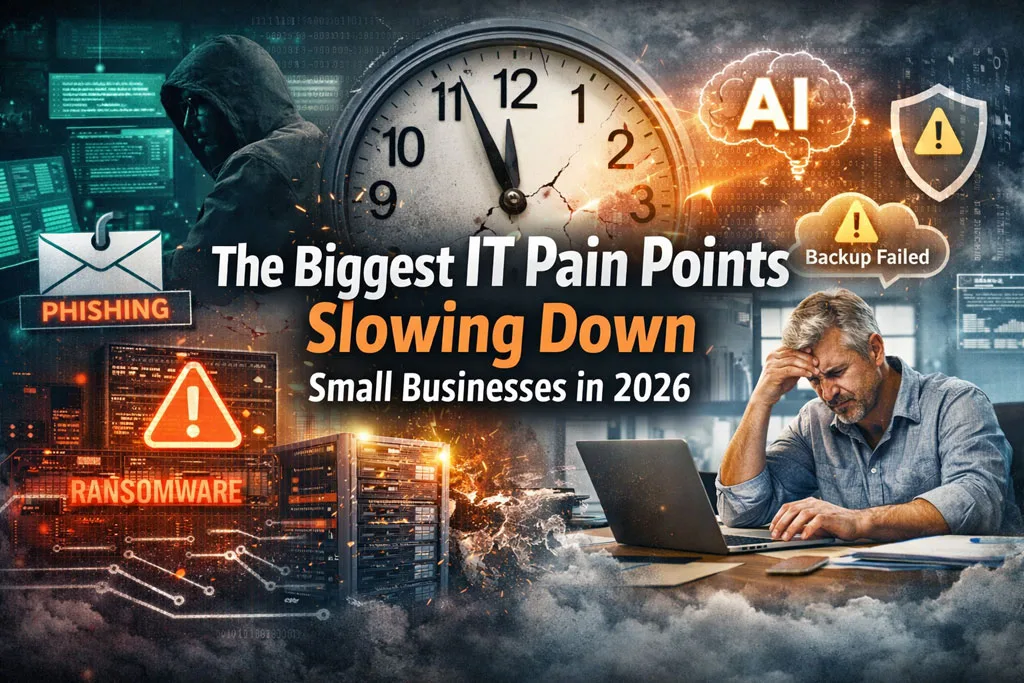
Small businesses are moving faster than ever, but many are still being held back by the same technology issues that quietly drain time, money, and momentum. The biggest IT pain points slowing down small businesses in 2026 are no longer just “computer problems.” They are business problems. They affect customer service, staff productivity, security, compliance, and growth.
For companies in Palm Coast, Daytona Beach, St. Augustine, and Jacksonville, these challenges are showing up every day. Employees lose time to slow systems. Leaders worry about phishing emails. Old hardware causes delays. Microsoft 365 is often under protected. Backup plans look good on paper but fail when a real emergency happens. At the same time, more businesses are adopting AI tools without clear guardrails, which creates new risks around security, privacy, and compliance. Microsoft’s 2025 Digital Defense Report says financially motivated attacks such as ransomware, extortion, and data theft remain major drivers, while attackers continue to exploit known gaps and weak identity practices.
If you want to understand the biggest IT pain points slowing down small businesses in 2026, you need to look past surface-level tech complaints and focus on what is actually disrupting operations. Below are the issues that are costing small businesses the most, along with what to do about them.
Table of Contents
1. Cybersecurity is still the biggest business risk
The biggest IT pain points slowing down small businesses in 2026 start with cybersecurity. Many small businesses still think they are too small to be targeted, but attackers usually go after easy targets, not famous ones. Small companies often have fewer layers of protection, limited monitoring, weak password habits, and less formal staff training. That makes them attractive to cybercriminals.
Ransomware remains one of the most damaging threats for smaller organizations. Verizon’s 2025 DBIR says ransomware appeared in 44% of breaches reviewed and notes that small and medium-sized businesses are affected disproportionately. CISA also continues to emphasize that ransomware and phishing can be devastating for small organizations that do not have strong protections in place.
For local businesses in Palm Coast and Daytona Beach, this can mean canceled appointments, lost invoices, inaccessible files, and days of downtime. For law firms, healthcare practices, contractors, and financial offices in St. Augustine and Jacksonville, it can also mean serious data exposure and compliance headaches.
What to do:
Start with layered protection. Use multi-factor authentication, advanced email security, endpoint protection, patch management, regular vulnerability review, and a tested incident response process. For many businesses, working with a managed IT partner is the fastest way to reduce this pain point.
2. Phishing and identity attacks keep getting through
Another reason the biggest IT pain points slowing down small businesses in 2026 remain so costly is that phishing is getting harder to spot. Today’s phishing messages often look polished, urgent, and believable. Attackers are also taking advantage of identity-based attacks. Microsoft reports that 97% of identity attacks in one part of its 2025 findings were password spray attacks, showing how often attackers still win through weak and overused passwords. Microsoft also highlights AI-automated phishing and faster exploitation of common security gaps.
This is not just an enterprise issue. A small office in Jacksonville can receive the same fake Microsoft 365 login prompt as a much larger company. A small nonprofit in Palm Coast can be hit with the same invoice fraud email as a regional accounting firm in St. Augustine.
What to do:
Train staff regularly, not once per year. Enforce MFA everywhere possible. Use conditional access, strong password standards, and email filtering. Review login activity and create a clear process for reporting suspicious emails.
3. Outdated systems are slowing down productivity
Not every IT issue is dramatic, but many are expensive. The biggest IT pain points slowing down small businesses in 2026 include slow computers, unsupported operating systems, aging network gear, outdated software, and inconsistent updates. These issues often do not make headlines, but they frustrate staff and reduce output every single day.
An old PC that takes ten extra minutes to boot does not sound like much until that delay affects ten employees every morning. An outdated firewall may still “work,” but it may not support modern security controls. An unsupported application may still run, but it can create compatibility issues, security gaps, and file-sharing problems.
NIST’s Small Business Quick-Start Guide recommends maintaining an inventory of hardware, software, systems, and services, and assessing those assets for vulnerabilities so businesses can prioritize risk and improvements.
For businesses in Daytona Beach and Jacksonville trying to grow, old systems often become silent growth killers.
What to do:
Create an asset inventory. Identify end-of-life devices and software. Budget for phased refreshes instead of waiting for full failure. Standardize devices where possible so support becomes faster and more predictable.
4. Backups exist, but recovery is still untested
One of the biggest IT pain points slowing down small businesses in 2026 is the false sense of security around backups. Many businesses think they are protected because “the system backs up every day.” But when something goes wrong, they find out their backups are incomplete, inaccessible, unencrypted, too slow to restore, or never tested.
CISA’s ransomware guidance continues to stress the importance of reducing the likelihood and impact of ransomware incidents through sound preparation and recovery planning. NIST also frames recovery as a core part of a complete cybersecurity approach, not an optional extra.
This is a major issue for businesses in Palm Coast, St. Augustine, and surrounding areas that rely on cloud apps, shared drives, QuickBooks data, email archives, and line-of-business software. A backup is only valuable if it can restore the business quickly and accurately.
What to do:
Review what is actually being backed up. Confirm retention, encryption, recovery time, and restore testing. Separate backup from production where possible. Document who does what during recovery.
5. Microsoft 365 is widely used but often undersecured
The biggest IT pain points slowing down small businesses in 2026 often live inside Microsoft 365. Many businesses depend on Microsoft 365 for email, file sharing, Teams, OneDrive, and collaboration, but they still operate with minimal hardening. That means weak MFA policies, over-permissioned accounts, poor sharing controls, and no monitoring for suspicious sign-ins.
This is one of the biggest risks for local businesses because Microsoft 365 has become central to day-to-day operations. If an attacker gains access to one inbox or one admin account, the damage can spread fast across email, files, and communication.
Microsoft’s 2025 reporting reinforces that cybercrime remains financially motivated and that attackers continue to exploit known gaps, especially around identity and access.
What to do:
Harden Microsoft 365 with MFA, least privilege, secure sharing settings, alerting, mail authentication, device controls, and regular review of admin roles and external access.
6. AI is being adopted faster than policy
A newer addition to the biggest IT pain points slowing down small businesses in 2026 is unmanaged AI use. Teams are using AI for drafting, summaries, customer communication, research, and automation. That can improve productivity, but it also introduces risk when there is no policy, no training, and no visibility into what staff are entering into AI tools.
Microsoft describes AI as both a tool and a threat, noting that both defenders and adversaries are using it and that businesses need to understand the risks and opportunities at the same time.
For a small business in Jacksonville or Daytona Beach, this can create problems quickly. Staff may paste sensitive client data into public tools. AI-generated content may be inaccurate. Attackers may use AI to produce more convincing phishing messages. Leadership may approve AI tools without evaluating security or compliance implications.
What to do:
Create an AI acceptable use policy. Define approved tools, restricted data, review procedures, and staff expectations. Pair AI adoption with security awareness and leadership oversight.
7. Vendor and third-party risk is harder to manage
The biggest IT pain points slowing down small businesses in 2026 are not always internal. Many businesses rely on outside vendors for payroll, cloud storage, accounting systems, communication tools, payment processing, and specialized software. When one vendor has poor security or suffers a disruption, the business using that vendor also feels the impact.
NIST’s small business guidance specifically tells organizations to assess cybersecurity risks posed by suppliers and other third parties before entering formal relationships.
For a growing business in Palm Coast or St. Augustine, vendor sprawl can happen fast. Over time, that creates blind spots around access, shared data, contracts, and security responsibilities.
What to do:
Review your vendors. Know who has access to what. Ask about security practices, backup expectations, breach notification, and compliance responsibilities. Remove old vendor access when it is no longer needed.
8. IT support is reactive instead of strategic
Many owners feel the biggest IT pain points slowing down small businesses in 2026 because their support model only addresses symptoms. Something breaks, a ticket gets opened, and the problem gets fixed. Then the cycle repeats. That is not strategy. That is survival.
Small businesses need more than a break-fix approach. They need planning, visibility, standards, budgeting guidance, and proactive maintenance. NIST’s framework for small businesses includes governance, identification, protection, detection, response, and recovery, which is a reminder that modern IT has to support the business as a whole.
For businesses in Jacksonville, Palm Coast, Daytona Beach, and St. Augustine, a proactive partner can help reduce recurring problems, improve resilience, and align technology with business goals.
What to do:
Move toward proactive IT support that includes monitoring, planning, documented standards, lifecycle management, cybersecurity review, and regular strategy meetings.
Why this matters for businesses in Northeast Florida

The biggest IT pain points slowing down small businesses in 2026 are especially important for companies that want to grow without adding constant operational friction. Whether you serve clients in Palm Coast, Daytona Beach, St. Augustine, or Jacksonville, technology should help your business move faster, not create more roadblocks.
If your systems are slow, your staff is frustrated, your backups are untested, your Microsoft 365 environment is undersecured, or your team is using AI without guardrails, those are not isolated tech issues. They are business risks. They affect trust, service quality, staff efficiency, and long-term growth.
The good news is that these pain points can be fixed with the right plan, the right tools, and the right support.
Final thoughts
The biggest IT pain points slowing down small businesses in 2026 are clear: cybersecurity threats, phishing, outdated systems, weak backup planning, Microsoft 365 risk, unmanaged AI use, vendor exposure, and reactive support. These are the issues that quietly slow growth until they become expensive emergencies.
Small businesses do not need enterprise complexity to solve them. They need smart, practical, proactive IT support built around the way their business actually works.
If you are seeing any of these signs in your business, Zevonix is ready to help. We support small businesses in Palm Coast, Daytona Beach, St. Augustine, and Jacksonville with managed IT services, cybersecurity, Microsoft 365 protection, backup planning, and strategic guidance built for real-world growth.
Ready to reduce downtime, improve security, and get your technology working for your business?
Contact Zevonix today to schedule a consultation and see how we can help your business move forward with confidence.
📞 Call us at 904.658.0777
🔒 Book Your meeting with Zevonix »
Frequently Asked Questions
What are the biggest IT pain points slowing down small businesses in 2026?
The biggest IT pain points slowing down small businesses in 2026 include cybersecurity risk, phishing, slow or outdated systems, weak backups, poor Microsoft 365 security, unmanaged AI use, vendor risk, and reactive IT support.
Why are small businesses such common cyberattack targets?
Small businesses often have fewer security controls, less formal staff training, and limited monitoring, which makes them easier for attackers to compromise. Ransomware and identity-based attacks continue to hit smaller organizations hard.
How can a small business improve Microsoft 365 security?
A small business can improve Microsoft 365 security by enabling MFA, reviewing admin roles, tightening file-sharing settings, monitoring sign-ins, protecting endpoints, and training staff to recognize phishing attempts.
Why is backup testing so important?
Backups are only useful if they can be restored quickly and correctly. Testing helps confirm that your backup data is complete, accessible, and able to support real business recovery after an outage or cyberattack.
How can businesses in Palm Coast, Daytona Beach, St. Augustine, and Jacksonville reduce IT issues?
They can reduce IT issues by moving from reactive support to proactive planning, standardizing devices and security settings, testing backups, hardening Microsoft 365, and working with a trusted managed IT provider.
Stay Informed
Want smarter insights without the noise? Get our latest ideas and strategies delivered right to your inbox.
We respect your privacy. Unsubscribe at any time.