
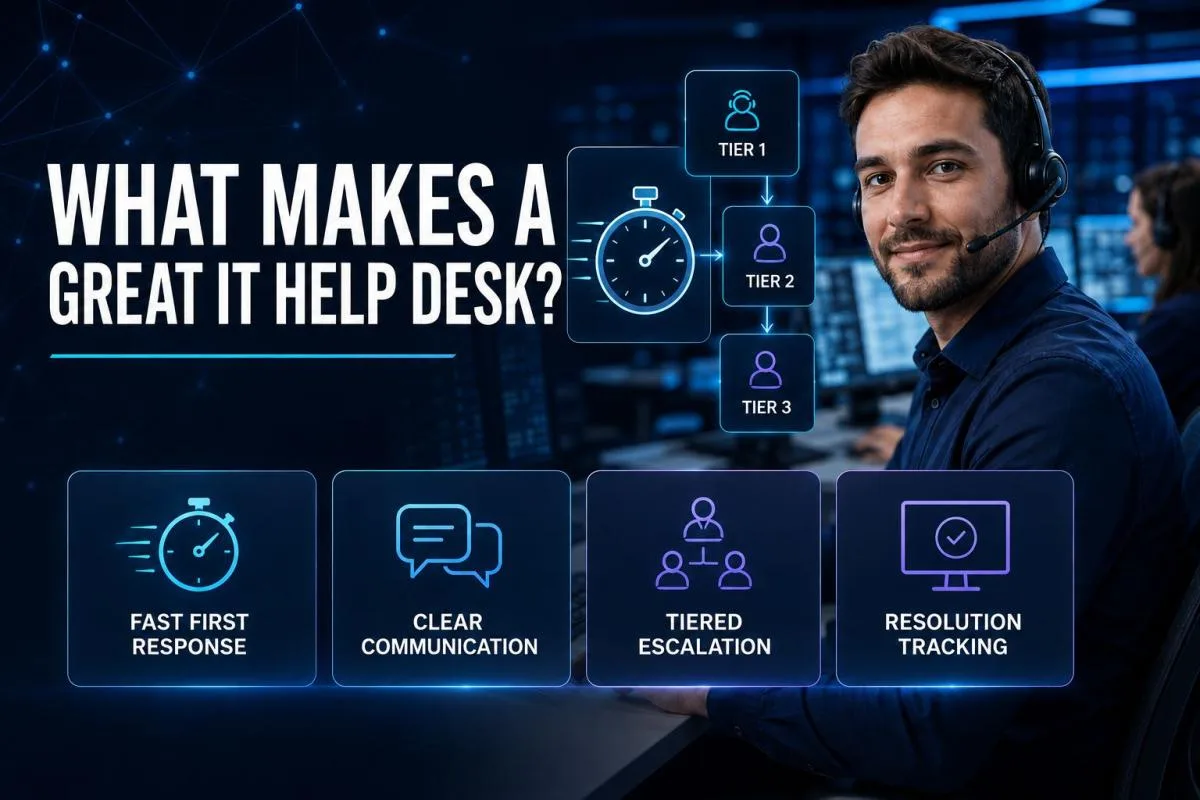
When something breaks, your team stops. A frozen laptop, a locked account, or email that won’t send can quietly cost you hours of lost work and a lot of frustration.
That’s why IT help desk support is one of the most important services a small business can have. It’s the front door to getting problems solved fast.
But not all support is created equal. Some providers answer in minutes; others leave you waiting half a day while your staff sits idle.
So how do you tell good support from mediocre support? This guide breaks down what an IT help desk actually does, the metrics that matter most, and the questions to ask before you sign with any provider.
What Makes a Great IT Help Desk? Table of Contents
What Is an IT Help Desk?
An IT help desk is the team you contact when technology stops working. Think of it as a single, dependable point of contact for every tech question or problem your business has.
You report an issue, the team logs it, and someone works to fix it. That covers everything from a forgotten password to a server that won’t come back online.
A good help desk does more than react, though. It tracks every request, spots patterns, and helps prevent the same problems from happening again.
Common issues a help desk handles include:
- Password resets and account lockouts
- Email and calendar problems
- Slow or frozen computers
- Printer and connectivity issues
- Software installs and updates
- Security alerts and suspicious messages
When you choose outsourced help desk support, an external provider handles all of this for you, so you don’t need a full IT department on your payroll.
Why IT Support Response Time Is the Metric That Matters Most
If you remember one thing from this article, make it this: IT support response time is the clearest signal of a quality help desk.
Response time is how long it takes someone to acknowledge your request and start working on it. Every minute your people wait is a minute they can’t do their jobs.
There’s a second number that matters too: resolution time, or how long it takes to actually fix the problem. A great provider is fast on both.
What a Good Benchmark Looks Like
As a general industry guide, a strong help desk acknowledges urgent issues within an hour, not at the end of the day. Slower than that, and small problems pile up into big disruptions.
At Zevonix, our standard is a response time of 30 minutes or less. That kind of benchmark is exactly what you should look for, a clear, committed number rather than a vague promise to “get to it soon.”
When you talk to a provider, ask them to put their response time in writing. If they can’t give you a specific figure, that tells you something.
Tiered IT Support Explained
Most quality help desks use a system called tiered IT support. This simply means problems are routed to the right level of expertise so they get solved efficiently.
You don’t want a senior engineer spending all day on password resets, and you don’t want a basic technician guessing at a complex network failure. Tiers keep the right people on the right work.
Tier 1: Everyday Fixes
This is the first line of support. Tier 1 handles the common, quick issues, password resets, account lockouts, simple software questions, and basic troubleshooting.
Many businesses find that the majority of their requests are resolved right here, fast.
Tier 2: Deeper Technical Issues
When a problem needs more skill, it moves to Tier 2. These technicians handle trickier software conflicts, email server issues, and configuration problems that Tier 1 can’t resolve.
Tier 3: Complex and Specialized Problems
Tier 3 is your top-level expertise. These are the engineers who tackle serious network failures, security incidents, and complicated infrastructure issues.
A healthy help desk moves tickets up the tiers smoothly, so nothing gets stuck or forgotten. Ask any provider how they escalate issues between levels.
Remote vs. Onsite Support
Most IT issues today are solved remotely, and that’s a good thing. With your permission, a technician connects to your computer securely and fixes the problem without anyone driving to your office.
Remote support is faster and keeps your costs down. It’s why a strong help desk can meet aggressive response times in the first place.
Some problems still need hands on the hardware, though. Failed equipment, network cabling, or a new office setup may require an onsite visit.
This is where local matters. A provider with people near you, across Florida and Georgia, can show up when remote fixes aren’t enough.
Ticketing, Reporting, and SLAs
Quality support is organized support. A professional help desk logs every request as a “ticket,” a tracked record of your problem from start to finish.
Ticketing matters because nothing falls through the cracks. You can see the status of your request, and the provider can measure how well they’re performing.
What an SLA Means for You
An SLA, or Service Level Agreement, is a written promise about the service you’ll receive. It spells out response times, priorities, and what counts as “urgent.”
Good managed IT support comes with a clear SLA and regular reporting. You should receive simple summaries showing how many issues came in, how fast they were handled, and where recurring problems are coming from.
Ask to see a sample report. If a provider can’t show you one, they probably aren’t measuring their own performance.
Proactive Monitoring: The Tickets You Never Have to File
Here’s the difference between average and excellent support: the best help desk prevents problems before you even notice them.
This is called proactive monitoring. Software keeps a constant eye on your computers, servers, and network, watching for warning signs around the clock.
A hard drive that’s about to fail, a security update that’s overdue, a system running low on space, these get flagged and fixed quietly, before they ever cause an outage.
Proactive monitoring means fewer emergencies, less downtime, and a calmer workday for your team. It’s a core part of how we deliver Zevonix help desk and IT support services.
User Training Reduces Tickets Too
Not every issue is a hardware failure. Many “problems” are simply moments where a staff member isn’t sure how to do something safely.
A thoughtful help desk helps your people learn, not just fixes their screens. Short, plain-English guidance on spotting phishing emails, using passwords well, and handling common tasks pays off quickly.
The result is fewer repeat tickets and a workforce that’s more confident and more secure.
Reactive vs. Proactive Support: The Big Difference
Reactive support waits for things to break, then fixes them. It’s the old model: you call, you wait, you hope.
Proactive support, the security-first approach we take at Zevonix, works to keep things running so you have fewer reasons to call in the first place.
When you evaluate any provider, ask a simple question: “What do you do to prevent problems, not just fix them?” The answer reveals whether you’re getting true partnership or just a phone number to call when you’re already in trouble.
Quick Checklist: What to Ask a Help Desk Provider
- What is your committed response time, in writing?
- How do you escalate complex issues between support tiers?
- Do you provide regular reporting and an SLA?
- What proactive monitoring do you include?
- Do you offer both remote and onsite support in my area?
Get IT Help Desk Support Built Around Fast Response
Great IT help desk support comes down to one promise kept consistently: when you need help, someone responds fast and fixes it right. With a 30-minutes-or-less standard, tiered expertise, and proactive monitoring, that’s exactly what Zevonix delivers to small and mid-sized businesses across Florida and Georgia, including Jacksonville, Palm Coast, Atlanta, and Savannah.
Ready to see what responsive, security-first support feels like? Contact Zevonix today and take the next step on your pathway to smarter IT.
Stay Informed
Want smarter insights without the noise? Get our latest ideas and strategies delivered right to your inbox.
We respect your privacy. Unsubscribe at any time.