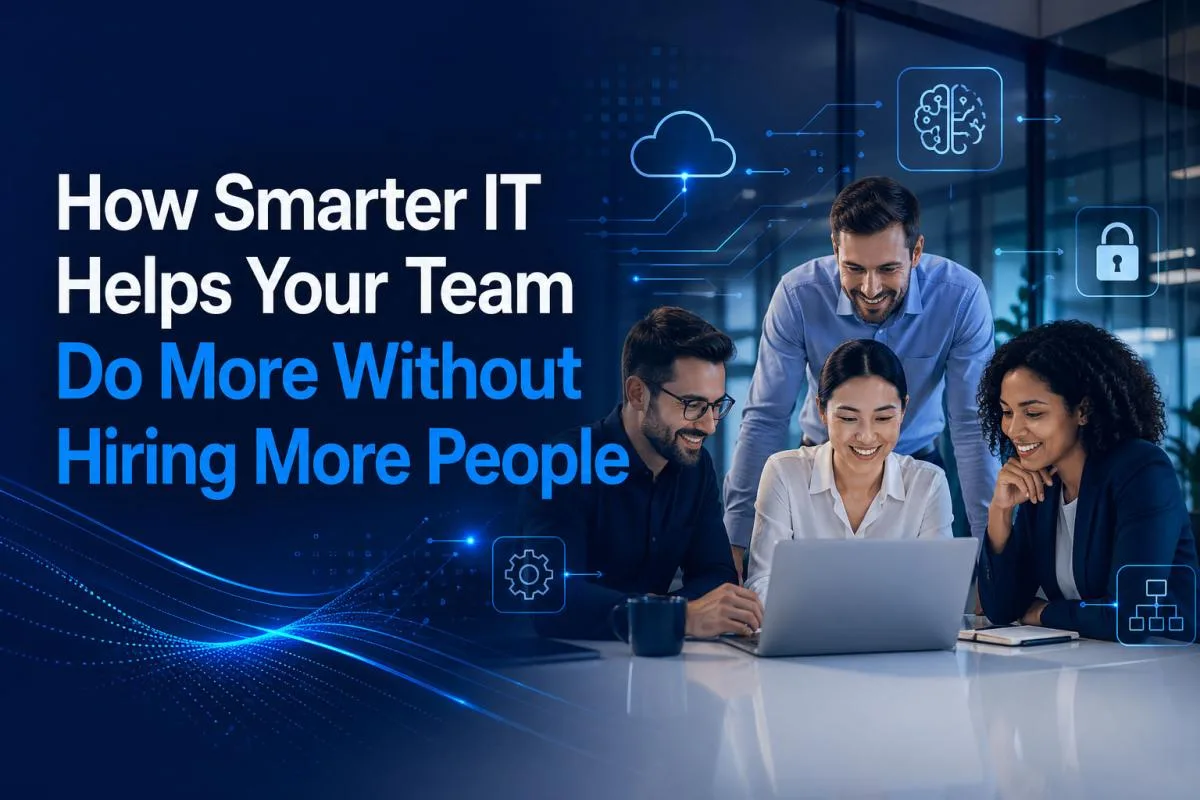
Hiring more people is not always the answer.
For many growing businesses, the real problem is not the size of the team. It tends to be the amount of manual work, the disconnected systems, repeated tasks, and technology friction slowing everyone down.
Your team may already be capable. They may already be working hard. They may already care deeply about doing a great job. But if they are buried in repetitive tasks, chasing information across systems, waiting on approvals, manually entering data, or dealing with unreliable technology, productivity suffers.
That is where smarter IT makes a difference.
Smarter IT is not just about having faster computers or better software. It is about building a technology environment that helps your business operate with less friction, fewer delays, and better visibility. It connects your tools, secures your access, automates routine work, and gives your team more time to focus on the work that actually moves the business forward.
For small and mid-sized businesses, smarter IT can be the difference between needing to hire another employee and helping your existing team do more with the resources you already have.
Table of Contents
What Does Smarter IT Really Mean?
Smarter IT means using technology with purpose.
It is not about buying every new tool or chasing every trend. It is about choosing the right systems, connecting them properly, securing them correctly, and using them in a way that supports the way your business actually works.
A smarter IT strategy may include:
- Automation for repetitive tasks
- AI tools that help with writing, research, reporting, and decision support
- Cloud platforms that allow secure access from anywhere
- Templates that reduce repeated work
- Secure file sharing and communication tools
- Workflow improvements that reduce bottlenecks
- Better cybersecurity protections
- Clear technology standards
- Managed IT support that keeps everything running smoothly
When these pieces work together, your business becomes more efficient. Your team spends less time fighting technology and more time serving customers, completing projects, and growing the company.
Why Businesses Feel Like They Need to Hire More People
Many business owners reach a point where they feel stretched thin.
The phones are ringing. Emails are piling up. Customer requests are increasing. Admin work is growing. Staff members are wearing too many hats. Managers are constantly following up on tasks. Important details are getting missed.
The first reaction is often, “We need another person.”
Sometimes that is true. But often, the bigger issue is that the business is operating with outdated processes.
For example:
- Employees manually copy information from one system to another
- Customer requests come in through email, phone, text, and website forms with no central tracking
- Documents are recreated from scratch every time
- Approvals happen through long email chains
- Staff members waste time looking for files
- Password resets and account issues interrupt the workday
- Reports are built manually instead of automatically
- No one has a clear view of what is pending, overdue, or completed
When this happens, your team does not need more work. They need better systems.
Smarter IT helps reduce the workload before you increase payroll.
Automation Helps Remove Repetitive Work
One of the biggest ways smarter IT helps your team do more is through automation.
Automation allows routine tasks to happen with less manual effort. This does not mean replacing your team. It means removing the repetitive work that keeps them from doing higher-value work.
For example, automation can help with:
- Sending customer follow-up emails
- Assigning new leads to the right person
- Creating tasks when a form is submitted
- Sending reminders before deadlines
- Updating records between systems
- Generating reports
- Notifying staff when approvals are needed
- Routing support requests
- Backing up important data
- Monitoring systems for issues
Think about how much time your team spends doing the same task over and over. Even saving 10 minutes per task can add up quickly across weeks and months.
A business that automates routine work can often increase output without increasing headcount.
AI Can Help Your Team Work Faster
Artificial intelligence is becoming a practical tool for everyday business operations.
For small businesses, AI can help employees move faster by supporting tasks such as:
- Drafting emails
- Summarizing long documents
- Creating meeting notes
- Reviewing policies
- Building outlines
- Generating marketing ideas
- Organizing customer information
- Answering common internal questions
- Helping with first drafts of reports
- Identifying patterns in data
The key is using AI safely and strategically.
AI should not be treated as a magic button. It should be guided by clear business rules, secure access, and human review. Your team still needs judgment, experience, and accountability. But with the right setup, AI can become a powerful assistant that helps employees get through work faster.
For example, instead of spending an hour drafting a customer update, an employee may use AI to create a first draft in minutes, then review and personalize it. Instead of reading through pages of notes, a manager may use AI to summarize key action items. Instead of starting from a blank page, your marketing team can use AI to brainstorm ideas and create outlines.
Smarter IT helps businesses use AI in a way that is useful, secure, and aligned with real workflows.
Cloud Tools Make Work Easier From Anywhere
Modern businesses need flexibility.
Your team may work from the office, from home, on the road, or across multiple locations. Cloud tools make it easier for employees to access what they need without being tied to one physical computer or office network.
Cloud tools can support:
- Email and calendars
- File storage and sharing
- Team communication
- Project management
- Customer relationship management
- Accounting platforms
- Document collaboration
- Video meetings
- Secure application access
When cloud tools are configured correctly, your team can work more efficiently while your business maintains control over security and access.
The important phrase is “configured correctly.”
Cloud tools can create risk if they are set up poorly. Weak passwords, missing multi-factor authentication, open file sharing, unmanaged devices, and poor permission settings can expose sensitive business information.
Smarter IT makes cloud tools productive and secure.
That means your team gets the flexibility they need, while your business keeps control over data, access, and compliance requirements.
Templates Reduce Repeated Work
Not every productivity improvement needs to be complicated.
Sometimes, one of the easiest ways to help your team do more is to stop making them recreate the same work from scratch.
Templates can save time across many areas of the business, including:
- Customer proposals
- Onboarding checklists
- Employee training materials
- Service agreements
- Project plans
- Email responses
- Meeting agendas
- Standard operating procedures
- Invoice descriptions
- Security checklists
- Internal request forms
Templates create consistency. They reduce mistakes. They help new employees learn faster. They also make sure your team is not reinventing the wheel every time a common task comes up.
For example, if your business sends similar follow-up emails every week, create approved templates. If your team handles onboarding the same way for each client, create a checklist. If your managers run similar meetings, create a meeting structure.
Smarter IT helps organize and store these templates so the right people can access the right documents at the right time.
Secure Access Keeps Productivity Moving
Security and productivity should not work against each other.
Many businesses either make access too loose or too difficult. If access is too loose, the business is exposed to cyber threats. If access is too difficult, employees find workarounds, which can create even more risk.
Smarter IT balances both.
Secure access may include:
- Multi-factor authentication
- Conditional access policies
- Role-based permissions
- Device management
- Secure cloud application access
- Password management
- Single sign-on
- Data loss prevention controls
- Information protection policies
The goal is simple: the right people should have access to the right systems, from the right devices, under the right conditions.
This helps reduce security risk while keeping work moving.
For example, an employee may be allowed to access company email from an approved device with multi-factor authentication. Sensitive files may only be available to specific departments. Login attempts from unusual locations may be blocked or challenged. Former employees can have access removed quickly across systems.
When access is managed properly, your team spends less time dealing with login issues, permission confusion, and security interruptions.
Workflow Improvements Help Remove Bottlenecks
Many productivity problems are actually workflow problems.
A workflow is the path work follows from start to finish. When that path is unclear, slow, or overly manual, your team loses time.
Common workflow issues include:
- No clear owner for a task
- No deadline visibility
- Too many approval steps
- Manual handoffs between departments
- Information stored in too many places
- No consistent process for customer requests
- Lack of reporting
- Duplicate data entry
- Poor communication between systems
Smarter IT helps identify and improve these bottlenecks.
For example, a business may have customer requests coming in through email. Some requests are answered quickly. Others get buried. Some are handled twice. Some are missed completely.
A smarter workflow may route those requests into a shared ticketing or task system. Each request gets assigned, tracked, prioritized, and completed. Managers can see what is open. Employees know what they own. Customers get faster responses.
The work did not change. The system around the work improved.
That is the power of smarter IT.
Better Communication Tools Reduce Confusion
Poor communication wastes time.
Employees may search through email threads, ask the same questions multiple times, or miss important updates because communication is scattered.
Smarter IT helps businesses use communication tools more effectively.
This may include:
- Shared channels for teams or departments
- Clear rules for when to use email versus chat
- Shared calendars
- Project dashboards
- Centralized documentation
- Internal knowledge bases
- Meeting notes and action item tracking
- Automated notifications
The goal is not to add more noise. The goal is to make communication easier to follow.
When communication tools are properly organized, employees know where to find information. Managers can reduce repeated follow-ups. Customers receive better service because the team is aligned.
Managed IT Support Helps Prevent Downtime
Your team cannot do more if systems are constantly breaking.
Unstable technology creates hidden costs. Every frozen computer, password issue, printer problem, network outage, email problem, or software error takes time away from productive work.
Managed IT support helps reduce those disruptions.
A proactive managed IT approach may include:
- Monitoring devices and systems
- Applying security updates
- Managing backups
- Reviewing account access
- Supporting users
- Maintaining cloud services
- Securing endpoints
- Managing antivirus or endpoint detection tools
- Improving network performance
- Planning technology upgrades
Instead of waiting for things to break, managed IT focuses on prevention.
This matters because downtime does not only cost money. It also frustrates employees, delays customers, and creates stress across the business.
Smarter IT keeps your team moving.
Cybersecurity Is Part of Productivity
Some business owners think of cybersecurity as a separate issue from productivity.
It is not.
A cyberattack can stop work completely. A compromised email account can create financial fraud. A ransomware incident can lock critical files. A data breach can damage customer trust. Even a small security issue can consume days or weeks of attention.
Smarter IT includes cybersecurity because secure systems are more reliable systems.
Security protections may include:
- Multi-factor authentication
- Endpoint protection
- Email security
- DNS filtering
- Cloud backup
- Security awareness training
- Access reviews
- Patch management
- Dark web monitoring
- Incident response planning
- Data protection policies
The goal is to reduce risk without slowing the team down.
A secure business can operate with more confidence. Employees know what to do. Leaders have better visibility. Systems are better protected. Customers are better served.
Smarter IT Helps You Get More Value From Existing Tools
Many businesses already pay for powerful software, but only use a small part of what it can do.
This is especially common with platforms like Microsoft 365, Google Workspace, CRMs, accounting platforms, project management tools, and industry-specific applications.
Your business may already have access to features that can improve productivity, such as:
- Shared calendars
- Secure file sharing
- Document collaboration
- Forms
- Task lists
- Workflow automation
- Email rules
- Approval flows
- Data protection settings
- Meeting tools
- Reporting dashboards
The issue is not always needing more software. Sometimes the issue is needing better configuration, training, and adoption.
Smarter IT helps you get more value from tools you may already be paying for.
That can reduce waste, improve adoption, and help your team work more efficiently without adding more subscriptions or employees.
How Smarter IT Supports Growth
Growth can expose weaknesses in your business systems.
A process that worked for 5 employees may not work for 15. A spreadsheet that worked for 20 customers may not work for 200. A shared inbox that worked in the beginning may become a source of confusion as the business grows.
Smarter IT helps prepare your business for growth by creating structure.
This includes:
- Standardized processes
- Secure user onboarding and offboarding
- Centralized file management
- Reliable backups
- Clear access controls
- Scalable cloud systems
- Documented workflows
- Better reporting
- Stronger cybersecurity
- Improved support
When your systems are scalable, growth becomes easier to manage.
You can add employees, customers, locations, or services without rebuilding everything from scratch.
Signs Your Business Needs Smarter IT
Your business may need smarter IT if you are seeing any of these issues:
- Your team is constantly busy but important work still falls behind
- Employees repeat the same manual tasks every week
- Customer requests are hard to track
- Files are scattered across email, desktops, and cloud folders
- You rely heavily on spreadsheets for critical operations
- Staff members ask the same questions often
- You do not have clear access controls
- Remote work is difficult or insecure
- Reporting takes too long
- New employee onboarding feels inconsistent
- You are paying for software that is underused
- Your team feels like they need more people just to keep up
These are not just operational problems. They are technology strategy problems.
The good news is that many of them can be improved with the right IT plan.
Smarter IT Does Not Replace People
It is important to be clear: smarter IT is not about replacing your team.
It is about helping your team work better.
Your employees bring judgment, experience, relationships, creativity, and care. Technology should support those strengths, not bury them under busywork.
When smarter IT is done well, your team can:
- Spend less time on repetitive tasks
- Respond to customers faster
- Reduce mistakes
- Find information quickly
- Collaborate more easily
- Work securely from more locations
- Make better decisions
- Focus on higher-value work
That is how businesses become more productive without immediately adding more payroll.
How Zevonix Helps Businesses Build Smarter IT

At Zevonix, we help businesses use technology as a growth tool, not just a support expense.
Our approach focuses on practical improvements that help your team work better, stay secure, and reduce technology frustration.
Through our Pathway to Smarter IT, we help businesses review their current systems, identify gaps, improve workflows, secure access, and create a technology plan that supports long-term growth.
Zevonix can help with:
- Managed IT services
- Cybersecurity improvements
- Microsoft 365 and cloud configuration
- Secure access policies
- Workflow automation
- AI readiness and managed AI services
- Website and cloud infrastructure support
- Backup and disaster recovery planning
- IT strategy and consulting
- Ongoing support and optimization
We do not believe technology should make work harder. We believe it should help your team operate with confidence, clarity, and control.
Final Thoughts: Before You Hire, Fix the Workflow
Hiring more people can help a growing business, but it should not be the only solution.
Before increasing payroll, look at where your team is losing time.
Are they repeating manual tasks? Are they searching for information? Are they waiting on approvals? Are systems disconnected? Are cloud tools poorly configured? Are security settings creating confusion? Are employees using workarounds because the process is too difficult?
These are signs that your business may not need more people first. It may need smarter IT.
With the right automation, AI tools, cloud systems, templates, secure access, and workflow improvements, your existing team can often accomplish more without feeling overwhelmed.
Smarter IT helps your business reduce friction, improve productivity, and prepare for growth.
And that is exactly what modern businesses need.
Ready to Help Your Team Do More With Smarter IT?
If your team is working hard but still feeling stretched, Zevonix can help you find the technology gaps slowing your business down.
We help businesses build secure, efficient, and practical IT systems that support growth without unnecessary complexity.
Contact Zevonix today to start your Pathway to Smarter IT.
Schedule Your Free Consultation
📞 Call us at 904.658.0777
🔒 Book Your meeting with Zevonix »
Frequently Asked Questions About Smarter IT
What is smarter IT for small businesses?
Smarter IT for small businesses means using technology, automation, cloud tools, AI, cybersecurity, and better workflows to help a team work faster, safer, and more efficiently.
How does smarter IT help employees be more productive?
Smarter IT helps employees be more productive by reducing manual work, improving access to information, automating routine tasks, and making business systems easier to use.
Can smarter IT help my business grow without hiring more people?
Yes. Smarter IT can help your business grow without hiring more people by helping your current team save time, reduce mistakes, and complete more work with better systems and processes.
What business tasks can be automated?
Common business tasks that can be automated include follow-up emails, appointment reminders, lead routing, task assignments, invoice reminders, customer requests, reporting, employee onboarding, and approval workflows.
How can AI help a small business team?
AI can help a small business team draft emails, summarize documents, organize notes, create reports, generate ideas, review information, and speed up repetitive office work.
What are examples of smarter IT tools?
Examples of smarter IT tools include Microsoft 365, Google Workspace, cloud storage, password managers, project management tools, CRM systems, AI assistants, automation platforms, backup tools, and cybersecurity software.
Stay Informed
Want smarter insights without the noise? Get our latest ideas and strategies delivered right to your inbox.
We respect your privacy. Unsubscribe at any time.