
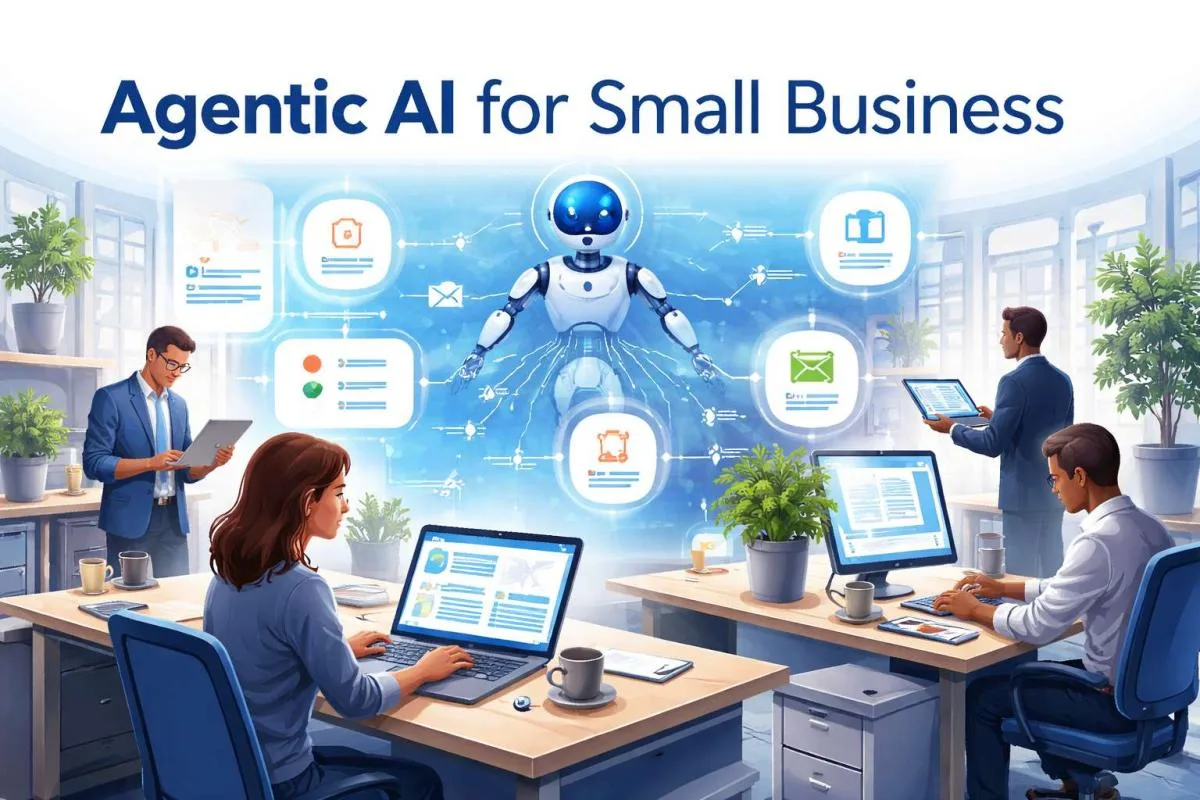
Artificial intelligence is changing fast. In 2025, many small and midsize businesses were still focused on chatbots, content generation, and prompt-based tools. In 2026, the conversation is moving in a more practical direction. Business owners are now asking a better question: can AI do the work, not just talk about it?
That shift is what many experts now describe as agentic AI. Instead of simply answering questions, agentic AI can gather context, follow rules, route tasks, trigger actions, and keep work moving across systems. Microsoft describes this as the move from AI that responds to AI that participates in executing work across tools and processes.
For small businesses, this matters more than ever. The companies gaining real value from AI are not just using it to write emails or summarize notes. They are using it to automate lead routing, support inventory planning, improve internal coordination, and reduce the manual work that slows teams down. Salesforce reports that 75% of SMBs are already investing in AI, and more than a third say AI is fully integrated into daily operations.
At Zevonix, we believe this is the next major step in managed IT and managed AI services. SMBs do not need more disconnected tools. They need practical, secure, customized AI workflows that reduce friction and help their teams do more with less.
Table of Contents
What Is Agentic AI?
Agentic AI is an artificial intelligence system that can pursue a goal with limited supervision. IBM defines it as AI that can accomplish a specific goal with limited supervision, using agents that solve problems in real time and coordinate subtasks as part of a larger workflow.
In simpler terms, agentic AI goes beyond a chatbot.
A chatbot might answer, “What is the status of this order?”
An agentic system can do more:
- pull order data from one system
- check stock availability in another
- notify the right team member
- update a ticket
- send the next approved communication
- log the action for review
That is a major difference.
Traditional AI often waits for a person to ask the next question. Agentic AI can move work forward inside boundaries you define. Microsoft notes that these workflows can gather context, route tasks, and trigger follow-up steps automatically, which reduces coordination friction and manual handoffs.
Why SMBs Are Moving Beyond Simple Prompts
Small businesses have always needed efficiency, but now they also need resilience, speed, and better use of limited staff time. That is why so many SMB leaders are looking beyond novelty and toward practical workflow automation.
The old model of AI use was mostly reactive:
- write this email
- summarize this meeting
- rewrite this paragraph
- answer this question
The new model is operational:
- qualify and assign leads
- forecast inventory trends
- screen repetitive requests
- flag possible compliance issues
- support internal ticket handling
- trigger follow-up tasks automatically
McKinsey describes AI agents as a shift from reactive tools to proactive, goal-driven virtual collaborators that combine autonomy, planning, memory, and integration to automate complex business processes.
That shift is especially powerful for growing businesses that cannot afford bloated processes or excess admin work.
The Rise of the “SuperWorker”
One of the most important business trends right now is the idea of the SuperWorker. This does not mean replacing people. It means giving your current team better leverage.
A strong employee with the right systems can now do the work of a much larger team in certain areas. Salesforce reports that 60% of desk workers now use AI, 40% have worked with an AI agent, and 23% have already offloaded tasks to agents to complete on their behalf. The same research found daily AI usage rose 233% in just six months.
That is a major signal.
It tells us AI is no longer staying in the testing phase. It is becoming part of how work gets done. For SMBs, that can mean:
- a sales coordinator handling more inbound leads without delays
- an office manager reducing repetitive back-and-forth
- an operations team catching issues faster
- a service business moving tickets and approvals more smoothly
- a leadership team getting better visibility without more manual reporting
This is not just about productivity. It is about capacity.
When routine coordination work is handled faster and more consistently, your team has more time for client experience, strategy, relationship-building, and revenue-producing work.
Real SMB Use Cases for Agentic AI
For many business owners, the term agentic AI can sound abstract until they see how it applies to real workflows. Here are some of the most practical uses for small and midsize businesses.
1. Lead Routing and Sales Follow-Up
Instead of letting inbound leads sit in a shared inbox or get manually assigned, AI workflows can:
- read the inquiry
- identify service type or urgency
- assign the lead to the right person
- trigger a follow-up message
- log the action in a CRM
This reduces response time and helps prevent missed opportunities.
2. Inventory Forecasting and Operational Planning
Businesses with stock, materials, or parts can use AI-supported automation to:
- compare recent sales patterns
- flag low-stock risk
- suggest reorder timing
- alert the team when thresholds are met
This kind of support helps reduce both over-ordering and shortages.
3. Customer Service Coordination
Microsoft highlights customer service and operations as strong starting points for agentic workflows, especially when tasks require pulling data from multiple systems and coordinating the next step.
For SMBs, that can include:
- checking order or ticket status
- gathering customer history
- drafting an approved response
- escalating only when human review is needed
4. Basic Legal or Compliance Screening
Agentic workflows can assist with rule-based screening and documentation steps, especially when businesses need consistency. This is not a replacement for legal advice, but it can help teams:
- check for missing fields
- validate required steps
- flag potential policy mismatches
- maintain better process records
5. Internal IT and Administrative Workflows
AI can also support internal execution by coordinating requests, validating policy compliance, and triggering remediation steps inside defined limits. Microsoft specifically points to IT workflows as a strong use case when routine checks and escalations can move forward with less manual effort.
For Zevonix clients, this is where managed AI services become especially valuable. A workflow is only useful if it is connected, secure, and aligned with how your business actually operates.
Why Customized AI Beats Generic AI
This is where many SMBs get stuck.
They try a public AI tool, get a few decent answers, and assume they have “implemented AI.” But generic AI is not the same as business automation.
Real business value comes from customized AI workflows built around your actual processes.
That means:
- your lead flow
- your approval structure
- your CRM
- your inventory logic
- your support process
- your compliance needs
- your security requirements
Microsoft notes that agentic AI works best when built on a strong foundation that includes governance, permissions, monitoring, and accountability.
That is one reason many small businesses need a managed AI partner. You do not just need a model. You need the right design, controls, integrations, and oversight.
The Business Case for SMBs
AI is no longer just for large enterprises with big internal IT teams. Multiple recent reports show small businesses are adopting it quickly and seeing it as part of future growth.
Salesforce says 75% of SMBs are already investing in AI, while the U.S. Chamber of Commerce reported that nearly 60% of small businesses were using AI for business operations in 2025, more than double the share in 2023. The Chamber also found that 58% of small businesses say they use generative AI and 84% plan to increase their use of technology platforms.
That means the question is no longer whether AI will affect small business. It already is.
The real question is this:
Will your business use AI in a secure, strategic, and practical way, or will competitors get there first?
Where Zevonix Fits In
At Zevonix, we see agentic AI as part of a bigger business support strategy, not a standalone trend.
Our role is to help small and midsize businesses move from curiosity to useful implementation. That includes identifying the right workflows, building practical automations, keeping the environment secure, and making sure AI supports your team instead of creating confusion.
A good managed AI strategy should help your business:
- reduce repetitive admin work
- improve response times
- create better consistency
- support compliance-minded processes
- strengthen visibility across operations
- scale output without unnecessary hiring pressure
How SMBs Should Start with Agentic AI
The best approach is not to automate everything at once.
Start with a workflow that is:
- repetitive
- rules-based
- time-consuming
- easy to measure
- important, but not high-risk without review
Good early examples include:
- inbound lead triage
- client follow-up sequences
- internal request routing
- recurring reporting prep
- order or service status checks
- documentation and checklist validation
Then build from there.
Microsoft recommends phased implementation with controlled pilots, clear outcomes, human oversight, and strong monitoring. That is the right approach for SMBs too.
Final Thoughts
Agentic AI is not just another tech buzzword. It represents a real shift in how businesses can operate.
We are moving from AI that answers to AI that acts.
From prompts to process.
From isolated tasks to coordinated execution.
For small businesses, that opens the door to something powerful: smarter operations, stronger teams, and the ability to scale with more control.
The businesses that win with AI will not be the ones chasing every new tool. They will be the ones that build useful, secure, customized workflows that solve real business problems.
That is exactly where Zevonix can help.
If your business is ready to move beyond basic AI chat tools and start building real workflow automation, now is the time to create a practical roadmap.
Frequently Asked Questions
What is agentic AI for small business?
Agentic AI for small business refers to AI systems that do more than answer questions. They can follow rules, gather context, trigger actions, and move business workflows forward with limited supervision.
How is agentic AI different from a chatbot?
A chatbot usually responds to prompts. Agentic AI can execute parts of a workflow, such as routing leads, updating records, triggering follow-ups, or coordinating tasks across systems.
Can small businesses really use agentic AI?
Yes. Recent reporting shows SMB AI adoption is rising quickly. Salesforce says 75% of SMBs are already investing in AI, and the U.S. Chamber of Commerce found nearly 60% of small businesses are using AI in operations.
What are the best first use cases for SMBs?
The best starting points are repetitive, rules-based processes like lead routing, support triage, inventory alerts, internal approvals, and checklist validation. Microsoft identifies customer service, operations, and IT workflows as strong early use cases for agentic AI.
Does agentic AI replace employees?
No. In most SMB environments, it works best as a force multiplier. It reduces repetitive coordination work so employees can focus on customer service, decision-making, strategy, and higher-value tasks. Salesforce research shows workers are increasingly using AI and agents to improve productivity and offload routine work.
Why would I need managed AI services?
Managed AI services help ensure your workflows are built securely, connected to the right systems, aligned to your business goals, and monitored properly. This matters because agentic AI needs governance, permissions, oversight, and a phased rollout to deliver reliable business value.
Stay Informed
Want smarter insights without the noise? Get our latest ideas and strategies delivered right to your inbox.
We respect your privacy. Unsubscribe at any time.