
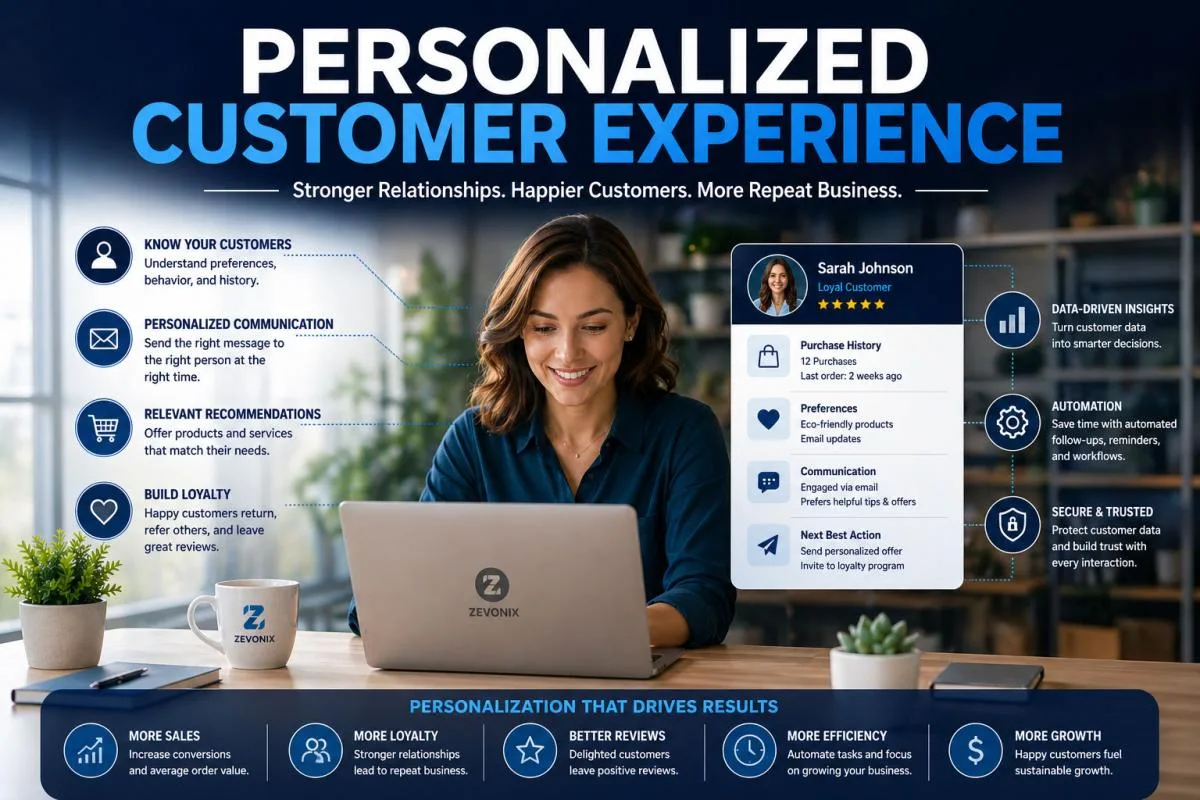
Personalized customer experience is no longer something only large companies can afford. Today, small businesses can use CRM systems, automation, analytics, AI tools, and secure cloud platforms to understand their customers better and serve them in a more meaningful way.
For years, small businesses had one major advantage over large companies: relationships. Owners knew their customers by name. Staff remembered preferences. Loyal customers came back because the business felt familiar, helpful, and personal.
That advantage still matters.
The difference today is that technology allows small businesses to scale that personal touch. Instead of relying only on memory, notebooks, spreadsheets, or scattered emails, businesses can use smart systems to track customer preferences, buying history, communication habits, service needs, and follow-up opportunities.
That is where personalized customer experience becomes powerful.
When done correctly, personalization helps small businesses create stronger relationships, increase repeat business, improve reviews, and stand out from competitors. It allows a business to make customers feel seen, understood, and valued.
And in a market where customers have more choices than ever, that matters.
Table of Contents
What Is Personalized Customer Experience?
Personalized customer experience means using customer information to create more relevant, helpful, and timely interactions.
This can include:
- Personalized product recommendations
- Follow-up emails based on past purchases
- Appointment reminders
- Service reminders
- Custom offers
- Birthday or anniversary messages
- Segmented email campaigns
- Personalized onboarding
- Better customer support history
- Automated follow-ups after service
- AI-assisted recommendations
- CRM-based customer notes and preferences
At its core, personalization is simple. It means treating customers like individuals instead of treating every customer the same.
A customer relationship management system, or CRM, helps businesses manage interactions with current and potential customers. Salesforce describes CRM as technology that helps companies stay connected to customers, streamline processes, and improve profitability.
For a small business, that can mean knowing who bought what, when they last contacted you, what service they needed, what they prefer, and when they may need help again.
Why Personalized Customer Experience Matters for Small Businesses
Small businesses compete against larger companies, online marketplaces, national brands, and local competitors. Many of those competitors have bigger budgets, larger teams, and more marketing resources.
But small businesses can win in a different way.
They can win through trust, speed, service, and personal attention.
Personalized customer experience helps small businesses take the relationship-building skills they already have and strengthen them with better technology.
Customers are increasingly expecting brands to understand their needs. Salesforce’s State of the AI Connected Customer report found that personalization and privacy expectations are both rising, and 73% of customers feel brands treat them as unique individuals.
That creates a major opportunity for small businesses.
If a customer already likes your business, trusts your team, and feels remembered, technology can help you build on that relationship. Instead of sending generic messages, you can send helpful communication based on what the customer actually needs.
That creates loyalty.
The Business Impact of Customer Experience Personalization
Personalized customer experience is not just a marketing idea. It can directly affect revenue, retention, referrals, and reputation.
When customers feel understood, they are more likely to return. They are also more likely to leave positive reviews, refer friends, and choose your business again even when a cheaper option exists.
Adobe explains that loyal customers are more likely to repurchase, advocate for a brand, and stay with a company even when things go wrong.
That is especially important for service-based businesses.
A medical practice, law firm, contractor, accounting firm, retail store, wellness office, real estate company, or professional service provider does not just need one-time transactions. They need repeat trust.
Personalization can help create that trust by making every customer interaction feel more intentional.
For example:
- A customer who bought a product can receive care instructions or reorder reminders.
- A patient can receive appointment reminders and follow-up instructions.
- A law firm client can receive case milestone updates.
- An accounting client can receive tax deadline reminders.
- A retail customer can receive product suggestions based on past purchases.
- A service client can receive maintenance reminders before a problem happens.
This is where small businesses can turn technology into loyalty.
How CRM Systems Help Small Businesses Personalize Customer Experiences
A CRM system is one of the most important tools for creating a personalized customer experience.
Without a CRM, customer information often gets scattered across inboxes, sticky notes, spreadsheets, text messages, employee memory, and disconnected software. That makes it hard to create a consistent experience.
With a CRM, a business can keep customer information in one organized place.
A CRM can help track:
- Contact information
- Purchase history
- Lead source
- Customer preferences
- Follow-up tasks
- Sales opportunities
- Support requests
- Email history
- Appointment notes
- Service history
- Customer status
- Marketing segments
Zoho describes CRM software as a repository that helps unite and streamline sales, marketing, and customer support activities.
For small businesses, this can make a major difference.
Instead of asking a returning customer the same questions every time, your team can see previous notes. Instead of forgetting to follow up, tasks can be automated. Instead of sending the same email to everyone, customers can be grouped by interest, service type, location, or purchase history.
That is personalization at scale.
Examples of Personalized Customer Experience for Small Businesses
Personalization does not need to be complicated. Many businesses can start with simple improvements that make customers feel better served.
1. Personalized Email Follow-Ups
A small business can send different email follow-ups based on what a customer purchased, requested, or asked about.
- A customer who downloaded a guide may receive educational content.
- A customer who booked a service may receive preparation steps.
- A customer who completed a project may receive a satisfaction survey.
- A customer who has not purchased recently may receive a friendly check-in.
HubSpot reports that email marketing remains one of the highest ROI channels for B2C brands, along with paid social media and content marketing.
For small businesses, personalized email can be one of the easiest ways to stay top of mind without overwhelming the customer.
2. Product or Service Recommendations
Personalized recommendations are common in e-commerce, but service businesses can use the same idea.
- A cybersecurity provider can recommend stronger email protection based on a client’s current risk.
- A medical office can remind patients about follow-up appointments.
- A contractor can recommend seasonal maintenance.
- A retailer can suggest related products.
- A financial professional can remind clients about annual reviews.
The key is relevance.
Customers do not want random messages. They want helpful ones.
3. Smarter Customer Support
When support teams have access to customer history, they can respond faster and more accurately.
A customer should not have to explain the same issue three times. A business should know what happened before, what was tried, and what the next step should be.
This is where CRM, ticketing systems, documentation, and automation work together.
For Zevonix clients, this is a major part of smarter IT. Technology should not only keep systems running. It should also help teams serve customers with less confusion, fewer delays, and better visibility.
4. Automated Reminders
Automation can help small businesses stay consistent.
- Appointment reminders
- Renewal reminders
- Maintenance reminders
- Invoice reminders
- Review requests
- Follow-up tasks
- Birthday or anniversary messages
- Service check-ins
These small touchpoints can make the business feel more organized and attentive.
5. Customer Segmentation
Customer segmentation means grouping customers based on shared traits or behaviors.
For example:
- New customers
- Repeat customers
- High-value customers
- Dormant customers
- Customers by location
- Customers by service type
- Customers by product interest
- Customers by industry
- Customers by past purchase
Segmentation allows businesses to send better messages.
A new customer may need onboarding. A repeat customer may appreciate a loyalty offer. A dormant customer may need a re-engagement email. A business client may need a different message than an individual consumer.
This is how personalization becomes practical.
The Role of AI in Personalized Customer Experience

AI is making customer experience personalization more accessible for small businesses.
AI can help analyze customer data, identify trends, write email drafts, summarize customer interactions, suggest next steps, and automate repetitive tasks.
But AI should not replace the human relationship.
It should support it.
For example, AI can help a business owner see which customers have not been contacted recently. It can suggest which leads are most likely to convert. It can help create personalized email content. It can summarize customer notes before a follow-up call.
Salesforce’s research focuses on how AI is changing customer sentiment, expectations, and behavior, especially as businesses work to balance trust, personalization, and customer value.
For small businesses, the real opportunity is not just using AI because it is trendy. The opportunity is using AI to give customers faster, more helpful, and more consistent service.
That is the Zevonix spin. AI should not feel cold, robotic, or disconnected. It should help your business deliver a better human experience.
The Privacy Side of Personalization
Personalization depends on data. That means businesses must be careful with how they collect, store, protect, and use customer information.
Customers may appreciate personalized service, but they also expect their information to be handled responsibly.
This is where many small businesses tend to make mistakes.
They collect customer data in forms, email inboxes, spreadsheets, CRMs, payment platforms, scheduling tools, and cloud storage. But they may not have strong access controls, backups, multi-factor authentication, device protection, or clear policies.
That creates risk.
A personalized customer experience should be secure by design.
Small businesses should ask:
- Who has access to customer data?
- Is multi-factor authentication enabled?
- Is the CRM protected?
- Are customer records backed up?
- Are employee devices secured?
- Is email protected against phishing?
- Are old users removed when employees leave?
- Is customer information stored in approved systems?
- Are marketing tools connected securely?
- Is sensitive data being shared through unsafe methods?
Personalization should never come at the cost of customer trust.
Why Small Businesses Struggle With Personalization
Most small businesses understand the value of better customer experience. The challenge is execution.
Common issues include:
- Customer data is scattered
- No CRM is in place
- The CRM is set up poorly
- Employees do not use the system consistently
- Marketing tools do not connect properly
- Reporting is unclear
- Follow-ups are manual
- Customer notes are inconsistent
- Automation feels overwhelming
- AI tools are not governed
- Data security is weak
- No one owns the process
This is why many businesses buy software but never get the full value from it.
The tool alone is not enough.
A CRM, email marketing platform, automation system, or AI tool only works when it is configured around the way the business actually operates.
That is where an IT and business technology partner like Zevonix can help.
The Zevonix Spin: Personalization Needs Smarter IT
At Zevonix, we believe better customer experiences come from better systems.
Personalization is not just a marketing project. It is an IT, security, data, workflow, and operations project.
A small business may want to send personalized emails, create better customer follow-ups, or use AI to improve service. But before that works well, the business needs the right foundation.
That foundation includes:
- Secure cloud systems
- A properly configured CRM
- Email and collaboration tools
- Device protection
- Data backup
- User access controls
- Automation workflows
- Reporting dashboards
- AI tools with guardrails
- Documentation
- Ongoing support
This is where Zevonix’s Pathway to Smarter IT fits naturally.
Discovery and Strategy
First, we look at how your business currently manages customer information. We identify where data lives, which tools are being used, what is manual, what is disconnected, and where the customer experience breaks down.
Tailored IT Solutions
Next, we help align the right tools to your business needs. That may include CRM setup, Microsoft 365 improvements, secure cloud access, email marketing integrations, workflow automation, or AI-supported processes.
Implementation and Deployment
Then we help put the systems in place. This includes setup, configuration, permissions, security, integrations, and staff guidance.
Ongoing Support and Optimization
Technology needs to evolve with your business. Zevonix helps monitor, maintain, and improve your systems over time so your customer experience keeps getting better.
Security Fortification
Personalization depends on customer data. Zevonix helps protect that data with cybersecurity best practices, secure access, endpoint protection, backups, and monitoring.
Growth and Innovation
Once the foundation is in place, your business can explore smarter automation, AI workflows, customer insights, and better reporting.
The goal is simple: help your business create a more personal, professional, and secure customer experience.
How to Start Personalizing Customer Experiences
Small businesses do not need to do everything at once.
Start with practical steps.
Step 1: Organize Your Customer Data
Identify where customer information currently lives. Look at email, spreadsheets, accounting software, scheduling systems, forms, contact lists, and notes.
Then decide where that information should live going forward.
For most businesses, that should be a CRM.
Step 2: Define Your Customer Journey
Map the customer experience from first contact to repeat business.
Ask:
- How does someone find us?
- What happens after they contact us?
- How do we follow up?
- How do we track conversations?
- How do we onboard new customers?
- How do we request reviews?
- How do we keep customers engaged?
- How do we win repeat business?
This helps identify where personalization can improve the experience.
Step 3: Segment Your Customers
Create simple customer groups.
You might start with:
- New leads
- Active customers
- Past customers
- High-value customers
- Customers by service type
- Customers by location
- Customers due for follow-up
This makes communication more relevant.
Step 4: Automate the Easy Follow-Ups
Start with low-risk automation.
Good examples include:
- Thank-you emails
- Appointment reminders
- Review requests
- Renewal reminders
- Post-service check-ins
- Educational email sequences
- Internal follow-up reminders
The goal is not to spam customers. The goal is to make sure important communication does not fall through the cracks.
Step 5: Use AI Carefully
AI can help with content, summaries, recommendations, and workflow support. But small businesses should use AI with clear rules.
- Do not paste sensitive customer data into random AI tools.
- Do not let AI send customer-facing messages without review.
- Do not connect AI tools to business systems without security review.
- Do not use AI without understanding where data goes.
AI can be powerful, but it should be implemented safely.
Step 6: Measure What Matters
Track whether personalization is helping.
Useful metrics include:
- Repeat purchase rate
- Customer retention
- Email open rates
- Email click rates
- Review volume
- Customer satisfaction
- Lead conversion rate
- Response time
- Follow-up completion
- Average customer value
If the numbers improve, personalization is working.
Personalized Customer Experience Examples by Industry
Healthcare Practices
Healthcare offices can personalize communication with appointment reminders, follow-up instructions, patient education, and secure messaging. The key is making sure systems are compliant, secure, and properly managed.
Law Firms
Law firms can personalize client updates, consultation follow-ups, document reminders, and case milestone communication. Clients often feel less anxious when they know what is happening.
Accounting Firms
Accounting firms can send deadline reminders, document request checklists, tax planning updates, and personalized business guidance.
Retail Stores
Retailers can recommend products, send loyalty offers, announce restocks, and invite customers to events based on past purchases.
Contractors and Home Service Businesses
Contractors can send seasonal maintenance reminders, warranty follow-ups, project updates, and service recommendations.
Nonprofits
Nonprofits can personalize donor thank-you messages, volunteer updates, event invitations, and impact reports.
In every case, the same rule applies: the customer experience improves when the message is relevant, timely, and useful.
Common Mistakes to Avoid
Personalization can help your business, but poor personalization can damage trust.
Avoid these mistakes:
- Sending too many emails
- Using incorrect customer names
- Making recommendations that do not match the customer
- Collecting data you do not need
- Using disconnected tools
- Failing to secure customer information
- Letting old employees keep access
- Using AI without privacy controls
- Buying software without a plan
- Automating bad processes
Technology should make the customer experience better, not more annoying.
The Future of Customer Experience for Small Businesses
The future of customer experience will be more personal, more automated, and more data-driven.
Customers will expect businesses to remember them, understand their needs, respond quickly, and provide helpful communication. At the same time, they will expect businesses to protect their personal information and respect their privacy.
That balance is where small businesses can win.
A business does not need to become a giant tech company. It just needs smarter systems, cleaner data, better workflows, and secure tools that help the team serve customers better.
Personalized customer experience is not about replacing people with technology.
It is about helping people deliver better service.
Final Thoughts
Personalized customer experience gives small businesses a powerful way to compete.
It helps customers feel remembered. It makes communication more relevant. It supports repeat business. It improves loyalty. It helps teams follow up consistently. It gives business owners better visibility into customer needs.
But personalization requires more than good intentions.
It requires the right CRM, secure systems, smart automation, reliable data, and a clear strategy.
That is where Zevonix can help.
At Zevonix, we help small businesses use technology to create better customer experiences, stronger security, and smarter operations. Whether your business needs CRM support, Microsoft 365 improvements, workflow automation, managed AI services, cybersecurity, or ongoing IT support, we help you build the foundation for a better customer journey.
Your customers already want to feel valued. Smarter IT helps you prove that they are.
Frequently Asked Questions
What is personalized customer experience?
Personalized customer experience means using customer information to create more relevant interactions, recommendations, messages, and support. It helps businesses treat customers like individuals instead of sending the same message to everyone.
Why is personalized customer experience important for small businesses?
Personalized customer experience helps small businesses build loyalty, improve repeat business, increase positive reviews, and stand out from competitors. It allows businesses to create stronger relationships with customers.
What tools help with customer experience personalization?
Common tools include CRM systems, email marketing platforms, analytics dashboards, automation tools, AI assistants, customer support platforms, secure cloud storage, and collaboration tools.
How can a CRM improve customer experience?
A CRM keeps customer information organized in one place. It helps businesses track conversations, preferences, purchases, follow-ups, sales opportunities, and support requests.
Can AI help small businesses personalize customer experiences?
Yes. AI can help summarize customer interactions, draft personalized messages, identify trends, suggest next steps, and support automation. However, AI should be used with proper privacy and security controls.
Is personalization safe for customer data?
Personalization can be safe when customer data is properly protected. Businesses should use secure systems, multi-factor authentication, access controls, backups, endpoint protection, and clear policies for handling customer information.
How does Zevonix help with personalized customer experiences?
Zevonix helps small businesses build the technology foundation needed for personalization. This can include CRM support, Microsoft 365, cybersecurity, automation, managed AI services, cloud systems, and ongoing IT support.
Stay Informed
Want smarter insights without the noise? Get our latest ideas and strategies delivered right to your inbox.
We respect your privacy. Unsubscribe at any time.