
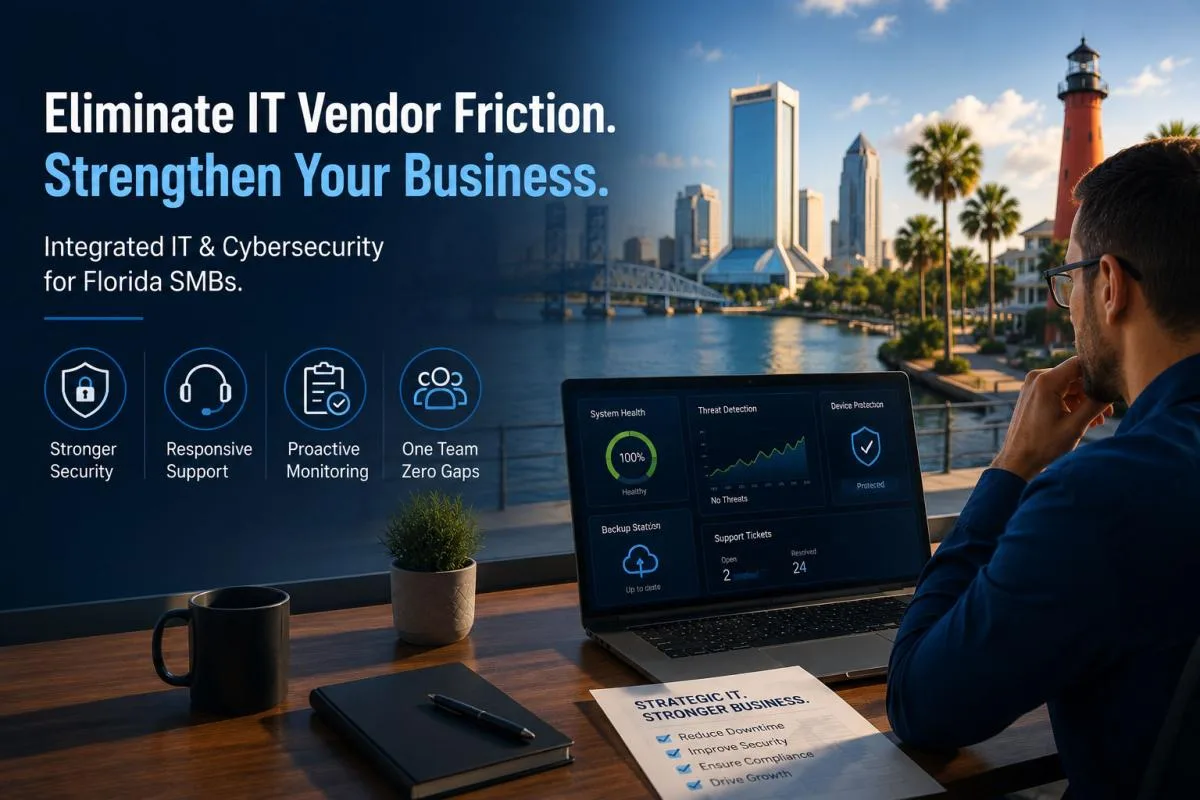
Florida businesses are becoming more dependent on technology every year. Cloud platforms, cybersecurity tools, remote work systems, compliance requirements, and Microsoft 365 environments now play a critical role in daily operations. Yet many small and medium-sized businesses still rely on multiple disconnected vendors to manage these systems.
That approach creates risk.
Companies searching for managed IT services Palm Coast solutions are increasingly discovering that fragmented IT support leads to slower response times, communication breakdowns, compliance concerns, and cybersecurity gaps. When one company handles IT support, another manages cybersecurity, and another controls backups or cloud infrastructure, accountability becomes unclear the moment something goes wrong.
That is why many Florida SMBs are moving toward a more unified strategy built around integrated IT and security services. Instead of juggling multiple providers, businesses are partnering with companies like Zevonix that deliver cybersecurity, support, monitoring, compliance guidance, and infrastructure management under one roof.
The result is a simpler, more secure environment with fewer operational gaps and faster problem resolution.
The True Cost of IT Vendor Friction: Why Florida SMBs Are Switching to Integrated Security and Support – Table of Contents
The Hidden Trap of Fragmented IT Support and Cybersecurity
Many business owners assume using multiple vendors reduces risk. In reality, it often creates confusion and operational friction that becomes difficult to manage as the business grows.
A healthcare office may have one vendor managing Microsoft 365, another handling cybersecurity monitoring, and a third responsible for network equipment. On paper, this setup appears flexible. In practice, it creates finger-pointing whenever outages, login issues, or cybersecurity incidents occur.
If email stops working, who owns the problem?
If a ransomware attack happens, which vendor responds first?
If backups fail, who is responsible for recovery?
These situations happen every day across Florida SMBs, especially among organizations that have grown quickly without developing a long-term IT strategy.
The biggest issue with fragmented support is the lack of centralized accountability. Every provider only sees a portion of the environment. That means security gaps can go unnoticed because no single team has complete visibility into systems, users, policies, and infrastructure.
Cybercriminals take advantage of those gaps.
Modern attacks often target weak connections between systems, vendors, and security controls. If firewall policies do not align with endpoint protection, or if cloud access rules are inconsistent, attackers can move through environments more easily.
Integrated IT and security providers reduce this risk significantly because they manage the environment as a complete ecosystem rather than isolated components.
Businesses looking for cybersecurity solutions Jacksonville companies can trust are increasingly prioritizing providers that combine IT support, cybersecurity, cloud management, compliance, and strategic guidance into one coordinated service model.
That unified approach improves both security and operational efficiency.
Common Signs of IT Vendor Friction
Businesses often experience vendor friction without realizing it. Some of the most common warning signs include:
- Vendors blaming each other during outages
- Slow response times during emergencies
- Multiple overlapping invoices
- Inconsistent cybersecurity policies
- Poor communication between providers
- Gaps in compliance documentation
- Unclear responsibility during incidents
- Duplicate or conflicting software tools
These issues create hidden costs that many businesses never calculate properly. Lost productivity, downtime, delayed response times, and compliance exposure often cost far more than the monthly service agreements themselves.
Why “Break-Fix” and Multi-Vendor Models Fail Growing SMBs
The traditional break-fix IT model was built for a different era. Years ago, businesses mainly needed occasional technical repairs, printer support, or basic workstation troubleshooting.
Today’s environments are far more complex.
Businesses now rely on cloud applications, remote access, cybersecurity compliance, identity management, encrypted backups, and constant connectivity. Waiting for something to break before taking action is no longer sustainable.
The same problem exists with multi-vendor support models. While each provider may specialize in a specific area, the overall environment becomes fragmented and difficult to coordinate.
The difference between fragmented support and integrated IT and security becomes clear when comparing daily operations.
| Fragmented Multi-Vendor IT | Integrated IT and Security |
|---|---|
| Multiple vendors and invoices | One unified support team |
| Reactive support model | Proactive monitoring and prevention |
| Vendors blame each other | Centralized accountability |
| Inconsistent security standards | Unified cybersecurity strategy |
| Slower issue resolution | Faster response times |
| Limited visibility across systems | Full operational visibility |
| Compliance gaps | Coordinated compliance support |
| Disconnected reporting | Centralized reporting and oversight |
Businesses using integrated providers gain more than convenience. They gain strategic alignment between support, cybersecurity, compliance, and business growth objectives.
That matters for Florida SMBs operating in regulated industries or highly competitive markets.
Organizations seeking managed IT services Palm Coast solutions are increasingly looking beyond basic technical support. They want long-term technology partners capable of helping them reduce risk, improve operational efficiency, and scale securely.
Integrated IT providers can proactively identify vulnerabilities, standardize systems, monitor threats, and streamline vendor management before problems escalate into costly disruptions.
Tailored IT Solutions for Northeast Florida Industries
Every industry has unique operational and compliance requirements. A healthcare practice faces very different risks than a law firm or accounting office. That is why tailored technology strategies are essential.
Businesses throughout Palm Coast, Jacksonville, and St. Augustine need solutions designed around their industry-specific workflows, security risks, and compliance obligations.
HIPAA-Compliant Managed IT Services Palm Coast Healthcare Needs
Healthcare organizations continue to be major targets for ransomware attacks and data breaches. Patient information remains extremely valuable to cybercriminals, and even small medical practices are now facing enterprise-level threats.
Unfortunately, many healthcare offices still operate with outdated infrastructure and disconnected vendors. One company may manage backups while another handles workstations and another oversees cybersecurity. This fragmented structure often creates dangerous compliance gaps.
Healthcare providers need technology environments built around security, reliability, and HIPAA-focused operational controls.
Modern managed IT services Palm Coast healthcare organizations require should include:
- Endpoint detection and response
- Multi-factor authentication
- Encrypted backup systems
- Microsoft 365 security management
- Security awareness training
- Centralized monitoring
- Incident response planning
- Compliance-focused documentation
Integrated IT and security providers simplify these environments by ensuring all systems work together under one coordinated strategy.
That reduces risk while allowing healthcare teams to focus on patient care instead of technology problems.
Internal Link Placeholder: Zevonix Palm Coast Location Page
Zero-Trust Data Protection for Legal and Accounting Firms
Law firms and accounting offices handle highly sensitive information every day. Financial documents, contracts, tax records, and confidential client communications require strong security controls and consistent oversight.
Many professional service firms still rely on outdated support structures that leave them vulnerable to phishing attacks, credential theft, and unauthorized access.
Integrated IT and security providers help implement modern zero-trust strategies that strengthen protection across the organization.
Zero-trust security assumes no device, user, or connection should automatically be trusted. Every access request must be verified continuously through layered security controls.
Businesses searching for reliable IT support St. Augustine providers are increasingly prioritizing security-first partnerships that combine proactive support with advanced cybersecurity protections.
For legal and accounting firms, this approach can include:
- Identity-based access management
- Secure remote work systems
- Centralized endpoint management
- Email security filtering
- Threat detection monitoring
- Secure cloud collaboration
- Data loss prevention
- Disaster recovery planning
These protections help reduce operational risk while supporting productivity and client trust.
Scaling the Flagler County Business Corridor Securely
Businesses across Flagler County continue investing in digital transformation, cloud adoption, and workforce mobility. As companies grow, their technology environments become more complex and more difficult to manage with disconnected vendors.
What works for a five-person office often breaks down at twenty or fifty employees.
Growth increases operational demands, cybersecurity exposure, and compliance expectations. Without centralized management, businesses often struggle to maintain consistency across devices, users, policies, and cloud systems.
Integrated IT and security providers help organizations scale more efficiently by standardizing systems and improving visibility across the entire environment.

This allows Florida SMBs to:
- Onboard employees faster
- Improve cybersecurity posture
- Standardize support processes
- Simplify vendor management
- Maintain compliance consistency
- Reduce downtime
- Improve remote workforce support
As cybersecurity threats continue evolving, businesses need strategic technology partnerships that support both operational growth and long-term security objectives.
One Unified Team, Zero Compliance Gaps
Technology should simplify operations, not create confusion between vendors.
Unfortunately, many businesses still operate in fragmented environments where cybersecurity, cloud systems, backups, and support are managed separately. That structure often leads to slower response times, operational inefficiencies, and security gaps that become increasingly expensive over time.
That is why more businesses are choosing integrated IT and security partnerships built around accountability, visibility, and proactive support.
Organizations searching for managed IT services Palm Coast solutions want more than basic troubleshooting. They want a trusted technology partner capable of protecting their business, supporting compliance goals, and reducing operational friction.
Zevonix helps Florida SMBs eliminate IT vendor friction through unified cybersecurity and managed IT services designed specifically for growing businesses, healthcare practices, and professional service firms throughout Northeast Florida.
One team. Zero gaps.
If your current vendors constantly shift responsibility or leave unresolved security concerns behind, it may be time for a more integrated approach.
Schedule a consultation with Zevonix today and discover how integrated IT and security can simplify your operations while strengthening your business for the future.
Frequently Asked Questions
What is IT vendor friction?
IT vendor friction happens when multiple technology vendors manage separate systems without coordination. This often leads to finger-pointing, slower response times, duplicate costs, and unresolved security or infrastructure issues.
How do managed IT services help healthcare practices?
Healthcare organizations benefit from managed IT services through HIPAA-focused cybersecurity protections, encrypted backups, secure Microsoft 365 management, endpoint monitoring, and proactive compliance support designed to reduce operational and security risks.
Why is proactive IT support better than break-fix support?
Break-fix support only responds after something fails. Proactive IT support continuously monitors systems, identifies vulnerabilities early, and helps prevent downtime before it impacts business operations.
How do managed IT services reduce downtime?
Managed IT services reduce downtime through proactive monitoring, patch management, backup systems, threat detection, and faster incident response. Integrated providers can also identify problems across the entire environment instead of isolated systems.
Stay Informed
Want smarter insights without the noise? Get our latest ideas and strategies delivered right to your inbox.
We respect your privacy. Unsubscribe at any time.