
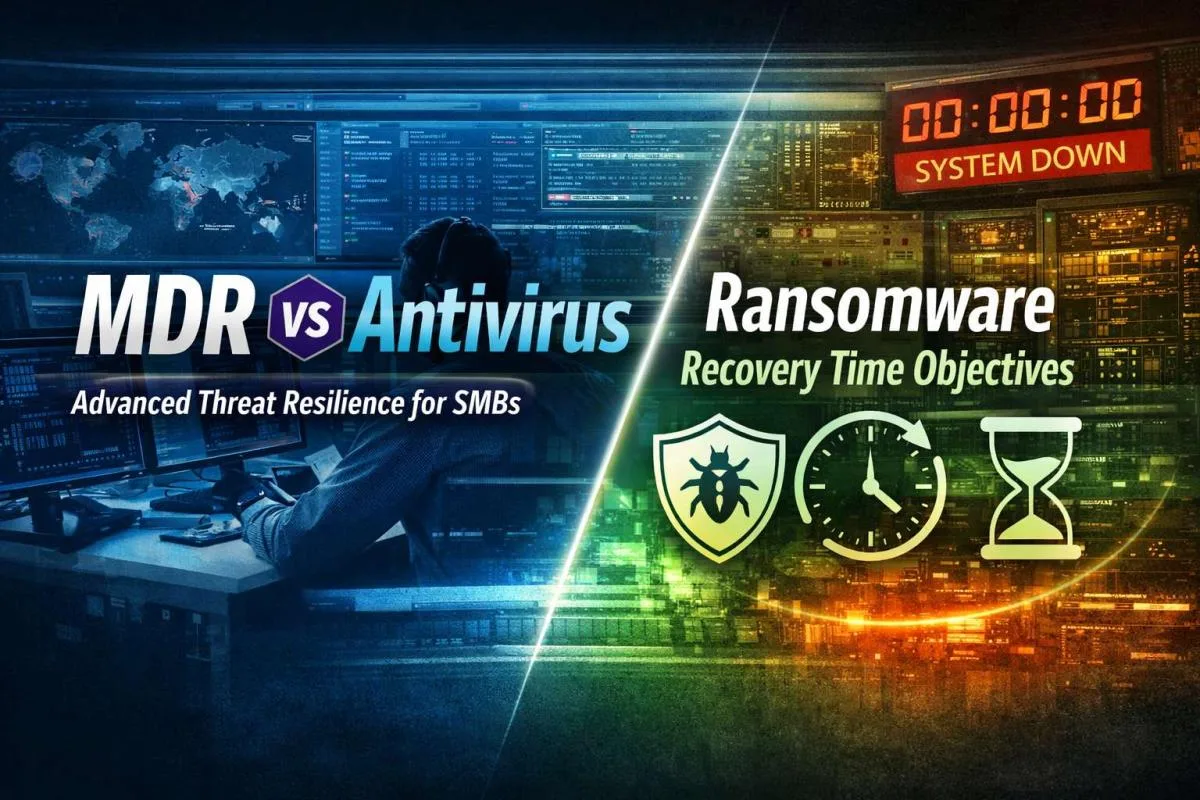
Small and midsize businesses are no longer asking whether they need cybersecurity. They are asking a more important question: what actually protects the business when a real attack happens? That is why searches like MDR vs antivirus and ransomware recovery time objectives are growing in relevance.
For many SMBs, traditional antivirus still plays a role, but it is no longer enough on its own. Modern attacks move faster, hide better, and often involve human-operated ransomware, lateral movement, credential abuse, and data theft. Microsoft defines managed detection and response, or MDR, as a service that combines technology with human expertise for threat hunting, monitoring, and rapid response. In contrast, antivirus is primarily designed to detect and block known malicious files and behaviors on endpoints.
That difference matters because the real business question is not just, “Can we block malware?” It is, “Can we detect an active threat, contain it quickly, and recover operations without devastating downtime?” NIST and CISA both emphasize recovery planning, tested backups, and timely restoration as core parts of ransomware resilience.
For SMBs, advanced threat resilience means building a security approach that covers prevention, detection, response, and recovery. That is the gap between basic protection and business-ready protection.
Advanced Threat Resilience for SMBs Starts with the Right Security Strategy – Table of Contents
MDR vs Antivirus: What Is the Real Difference?
When business owners compare MDR vs antivirus, they are usually comparing two very different levels of protection.
Antivirus is mainly focused on prevention. It looks for malicious files, suspicious code patterns, and known indicators of compromise. Modern antivirus products are better than the old signature-only tools of the past, but they still center primarily on stopping threats at the endpoint level. Microsoft notes that antivirus is a major component of endpoint protection, but advanced detection and response capabilities are handled through broader endpoint security platforms.
MDR, on the other hand, is a managed service built around continuous monitoring, threat detection, investigation, and response. Microsoft describes MDR as combining advanced detection with human-led analysis, threat hunting, and response actions through a SOC or outsourced security team.
In practical terms, antivirus asks:
“Is this file bad?”
MDR asks:
“What is happening across the environment right now, how dangerous is it, and what should be done immediately?”
That distinction is huge for SMBs. Antivirus may catch commodity malware. MDR is designed to help identify stealthier attacks, suspicious behavior, account misuse, and post-compromise activity that can otherwise go unnoticed until damage is already done. Microsoft’s endpoint detection and response guidance highlights near real-time, actionable detections that help analysts understand the scope of an attack and take response actions.
Why Antivirus Alone Is No Longer Enough for Many SMBs
Antivirus still has value. It should not be dismissed. But using antivirus alone as your primary cyber defense is similar to locking the front door while leaving the rest of the building unmonitored.
Today’s ransomware attacks often involve more than just a malicious file. Attackers may use stolen credentials, remote access tools, privilege escalation, persistence mechanisms, and data exfiltration before they trigger encryption. CISA’s ransomware response guidance stresses identifying affected systems, prioritizing restoration, and confirming what data resides on impacted assets, which shows how complex modern incidents can become.
This is why SMBs are increasingly searching for managed detection and response for small business rather than simply asking for antivirus recommendations. They know they need better visibility and faster action.
An antivirus alert without expert follow-up can sit untouched. An MDR service is designed to investigate, escalate, and in many cases help contain the threat before it spreads further. That can be the difference between one isolated device and a company-wide outage.
What SMBs Actually Need from MDR
Not all cybersecurity services are equal, and not every SMB needs enterprise-scale complexity. But most growing businesses do need a security model that helps with:
- 24/7 or extended-hours monitoring
- Alert triage and investigation
- Threat hunting
- Rapid containment guidance or direct response actions
- Endpoint visibility
- Escalation for suspicious behavior that antivirus may miss
- Support for ransomware response planning and recovery readiness
Microsoft’s description of MDR specifically includes proactive protection, advanced detection, and rapid incident response, supported by human expertise.
For SMBs, the real value of MDR is not just “more alerts.” It is fewer blind spots, faster decisions, and less dependence on internal staff who may not have time or cybersecurity specialization.
Ransomware Recovery Time Objectives: The Metric Too Many SMBs Ignore
The second major search trend here, ransomware recovery time objectives, is just as important as MDR vs antivirus.
A recovery time objective, or RTO, is the target amount of time your business can tolerate being down before serious operational damage occurs. NIST’s event recovery guidance explains that recovery objectives must account for system dependencies and help determine the sequence and timing for restoring operations.
That means ransomware recovery is not simply about having backups. It is about answering practical business questions like:
- How long can email be down?
- How long can your line-of-business app be unavailable?
- How fast can you restore servers, endpoints, and data?
- Which systems must come back first?
- Can your team actually execute the recovery plan under pressure?
NIST also recommends developing and regularly exercising an incident recovery plan, along with carefully planned, implemented, and regularly tested backup and restoration strategies.
This is where many SMBs discover a painful truth: having backups is not the same as having a recovery strategy.
Why Backups Alone Do Not Guarantee Fast Recovery
Business owners often assume that once backups are in place, ransomware risk is covered. That is not enough.
CISA recommends maintaining offline, encrypted backups and regularly testing their availability and integrity in a disaster recovery scenario. NIST similarly emphasizes testing recovery and restoration processes so organizations can resume normal operations more quickly.
Why does testing matter so much?
Because during a real ransomware event, you may discover that:
- the latest backup is corrupted
- the backup is reachable by the attacker
- restore speeds are too slow for business needs
- critical apps have hidden dependencies
- recovery order was never documented
- nobody is sure who owns the process
That is why ransomware recovery time objectives should be part of every SMB cybersecurity conversation. Your RTO turns recovery from a vague hope into a defined business target.
How MDR and Ransomware Recovery Planning Work Together
A lot of businesses compare MDR and antivirus as though the choice is only about detection. But the smarter comparison is this:
How does your security investment reduce business interruption?
MDR helps reduce dwell time by improving detection and accelerating response. A strong recovery plan reduces downtime by helping the business restore operations faster. Together, they create a much stronger resilience model.
Here’s the simple version:
- Antivirus helps block known threats
- MDR helps detect, investigate, and respond to advanced threats
- Backups help preserve recoverable data
- Recovery planning and RTOs help restore operations in a controlled, prioritized way
NIST’s ransomware guidance explicitly ties resilience to both response and recovery planning, while CISA continues to stress tested backups and preparation for restoration.
That is the heart of advanced threat resilience.
Signs Your SMB Has a Security Gap
If your business is relying mostly on antivirus, there may be a hidden resilience gap. Common warning signs include:
1. You have antivirus but no active monitoring
If no one is reviewing suspicious activity or investigating alerts, threats can linger longer than expected. MDR addresses this by adding human oversight and response capability.
2. You have backups but no tested recovery timeline
NIST and CISA both stress testing. If you have never timed a real restore, your actual ransomware recovery time objective is unknown.
3. You do not know which systems are most critical
NIST’s recovery guidance notes that dependencies matter when setting recovery objectives and sequencing restoration.
4. Your team assumes “the vendor handles it”
Cyber resilience is shared. Tools matter, but planning, roles, communication, and recovery workflows matter too.
How SMBs Should Think About MDR vs Antivirus
Here is the most honest way to frame the decision.
If your business is very small, has minimal regulatory pressure, has few endpoints, and can tolerate some disruption, antivirus may still serve as one layer of basic protection. But for SMBs that rely on uptime, handle sensitive data, or want to reduce ransomware risk in a meaningful way, the conversation should move beyond antivirus alone.
The better question is not MDR vs antivirus as an either-or debate.
The better question is:
Should antivirus be just one layer inside a broader managed security and recovery strategy?
For most growth-focused SMBs, the answer is yes.
Antivirus is a tool.
MDR is an operational capability.
Recovery planning is business resilience.
That combination is what aligns with how modern threats actually behave.
What a Better SMB Security Strategy Looks Like
A practical advanced threat resilience strategy for SMBs should include:
Layer 1: Preventive protection
Use modern endpoint protection, patching, MFA, and secure configuration baselines.
Layer 2: Detection and response
Add MDR or equivalent managed monitoring and response support so suspicious activity does not sit unnoticed.
Layer 3: Backup resilience
Keep backups offline or otherwise isolated, encrypted where appropriate, and regularly tested. CISA specifically recommends offline, encrypted backups and restoration testing.
Layer 4: Recovery objectives
Define ransomware recovery time objectives for critical systems, users, and processes. NIST’s recovery guidance supports setting recovery objectives based on dependencies and restoration sequence.
Layer 5: Exercises and improvement
Test the plan, measure recovery performance, and refine based on lessons learned. NIST recommends that ransomware response and recovery plans be tested periodically.
Final Thoughts: Advanced Threat Resilience Is About Business Survival
The growing interest in MDR vs antivirus and ransomware recovery time objectives shows that SMBs are getting more sophisticated. They are no longer satisfied with basic checkbox security. They want to know what will actually protect the business, reduce downtime, and support recovery after an attack.
That is exactly the right mindset.
Antivirus still has a place, but it is no longer the full answer. SMBs that want stronger protection should be thinking in terms of detection, response, recovery, and resilience. The businesses that prepare now will be in a far better position when the next serious cyber event hits.
If your company cannot clearly answer how fast it can detect a threat, contain it, and recover from ransomware, then now is the time to strengthen that strategy.
Schedule A Quick Consultation
📞 Call us at 904.658.0777
🔒 Book Your meeting with Zevonix »
Frequently Asked Questions
What is the difference between MDR and antivirus?
Antivirus primarily focuses on preventing known malware and suspicious files from running on devices. MDR adds continuous monitoring, expert investigation, threat hunting, and incident response support to help detect and contain advanced threats.
Is antivirus enough for a small business?
For some very small environments, antivirus may still be one useful layer, but many SMBs now need more than basic prevention. Modern attacks often involve account compromise, lateral movement, and ransomware activity that benefit from active monitoring and response.
What is a ransomware recovery time objective?
A ransomware recovery time objective is the target amount of time your business aims to restore critical operations after an incident. NIST explains that recovery objectives should consider dependencies and recovery sequence.
Why are tested backups important for ransomware recovery?
CISA and NIST both emphasize that backups should be regularly tested because successful recovery depends on restore integrity, availability, and execution, not just backup existence.
How can SMBs improve threat resilience?
SMBs can improve resilience by combining modern endpoint protection, MDR or managed monitoring, isolated backups, defined recovery time objectives, and regularly tested recovery plans.
Stay Informed
Want smarter insights without the noise? Get our latest ideas and strategies delivered right to your inbox.
We respect your privacy. Unsubscribe at any time.